Introduction
In today’s tech-driven world, Artificial Intelligence (AI) has become a crucial tool for businesses looking to streamline processes, enhance user experiences, and unlock new opportunities. Building an AI-powered application may seem daunting, but with the right approach and tools, it becomes an achievable endeavor. In this comprehensive guide, we’ll walk through the step-by-step process of building an AI app, covering everything from planning and data acquisition to model development and deployment.
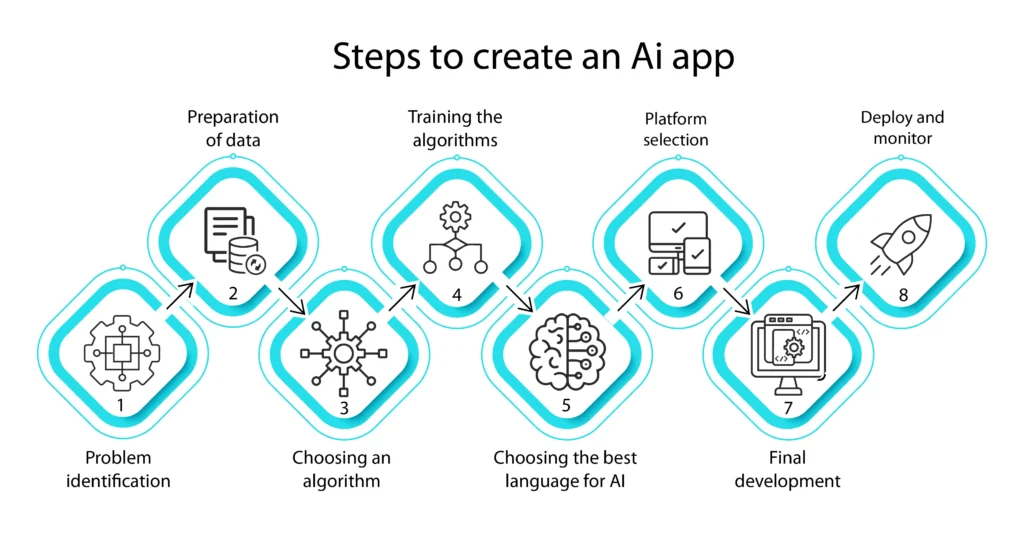
Step 1: Define Your Objectives
Before diving into development, it’s essential to clearly define the objectives of your AI application. Identify the problem you want to solve or the task you want to automate. Whether it’s improving customer service through chatbots, optimizing business operations with predictive analytics, or enhancing image recognition capabilities, having a clear goal will guide your development process.
Step 2: Choose the Right AI Techniques
Selecting the appropriate AI techniques is crucial for achieving your objectives. Common AI techniques include machine learning, natural language processing (NLP), computer vision, and deep learning. Assess which techniques align best with your application’s requirements and capabilities.
Step 3: Gather and Prepare Data
Data is the lifeblood of any AI application. Collect relevant data from diverse sources, ensuring it’s clean, labeled, and adequately prepared for analysis. Data preprocessing techniques such as normalization, feature scaling, and dimensionality reduction may be necessary to optimize data quality for training your AI models.
Step 4: Design and Train AI Models
With your data ready, it’s time to design and train your AI models. Choose the appropriate algorithms based on your objectives and data characteristics. Whether you’re building classification, regression, or clustering models, leverage popular machine learning libraries such as TensorFlow, PyTorch, or scikit-learn to streamline development. Fine-tune your models iteratively, evaluating their performance and adjusting parameters as needed.
Step 5: Integrate AI into Your Application
Integrating AI capabilities into your application requires seamless collaboration between data scientists, developers, and UX/UI designers. Ensure that the AI components are seamlessly embedded within the user interface, providing intuitive interactions and delivering actionable insights. Leverage APIs and SDKs provided by AI platforms to expedite integration and enhance functionality.
Step 6: Implement Feedback Mechanisms
Continuous improvement is key to the success of your AI application. Implement feedback mechanisms to gather user input and monitor performance metrics. Analyze user interactions, identify pain points, and iterate on your AI models accordingly. Embrace a culture of experimentation and adaptation to drive ongoing enhancements and optimize user satisfaction.
Step 7: Ensure Security and Privacy
Protecting user data and maintaining privacy are paramount considerations when building AI applications. Implement robust security measures to safeguard sensitive information and comply with regulatory requirements such as GDPR and CCPA. Utilize encryption, access controls, and anonymization techniques to mitigate security risks and build trust with your users.
Step 8: Test and Validate
Thorough testing and validation are essential to ensure the reliability and effectiveness of your AI application. Conduct rigorous testing across various scenarios, environments, and user inputs to identify and address potential issues. Employ techniques such as unit testing, integration testing, and user acceptance testing to validate functionality, performance, and user experience.
Step 9: Deploy and Monitor
Once your AI application has passed testing, it’s time to deploy it into production. Choose a deployment strategy that aligns with your infrastructure requirements, whether it’s cloud-based deployment on platforms like AWS or Azure, or on-premises deployment for enhanced control and security. Establish robust monitoring and logging mechanisms to track performance metrics, detect anomalies, and facilitate proactive maintenance and optimization.
Step 10: Iterate and Improve
Building an AI application is not a one-time effort but an ongoing journey of iteration and improvement. Continuously gather user feedback, monitor usage patterns, and analyze performance metrics to identify areas for enhancement. Embrace agile development methodologies to prioritize feature updates, address user needs, and stay ahead of evolving market trends.
Conclusion
Building an AI-powered application requires careful planning, execution, and iteration. By following the step-by-step guide outlined above, you can navigate the complexities of AI development and create innovative solutions that drive value for your business and users alike. Embrace collaboration, experimentation, and continuous improvement to unlock the full potential of AI and propel your application to success in the digital age.
 FinTech blogs
Leave a comment