Introduction:
In the fast-paced world of finance, compliance with regulatory standards is not just a necessity but a fundamental requirement. With the ever-evolving landscape of financial regulations, staying compliant has become increasingly complex and challenging for financial institutions. However, the integration of Artificial Intelligence (AI) technologies is revolutionizing the way financial compliance is approached, offering efficient solutions to navigate the intricate web of regulations.
Understanding AI in Financial Compliance:
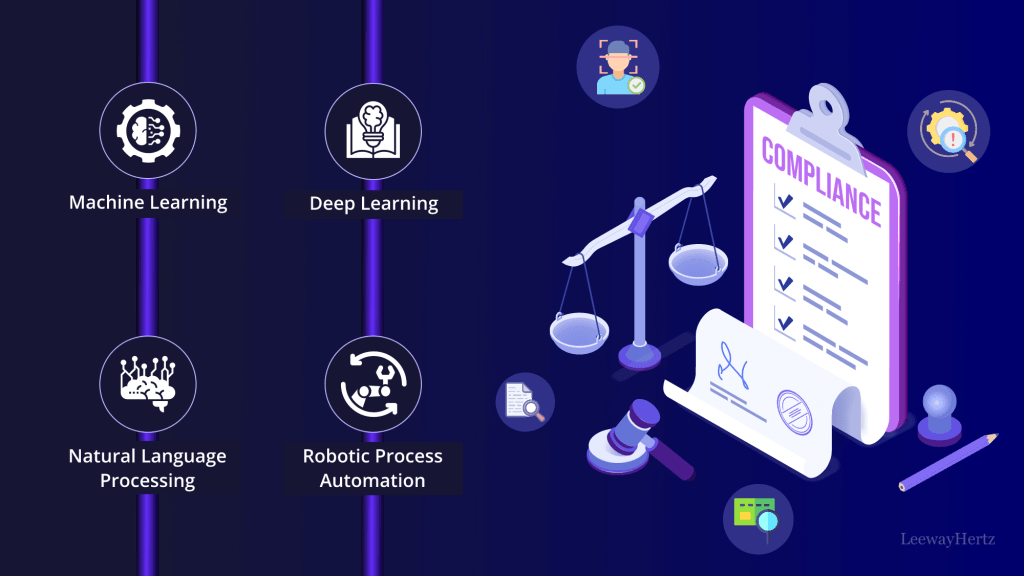
AI in financial compliance has emerged as a powerful tool , offering solutions that streamline processes, enhance accuracy, and reduce costs. By leveraging AI algorithms, financial institutions can automate repetitive tasks, analyze vast amounts of data, and detect patterns or anomalies that might indicate non-compliance.
Automating Regulatory Reporting:
One of the primary challenges in financial compliance is the timely and accurate submission of regulatory reports. Manual processes are not only time-consuming but also prone to errors. AI-powered solutions automate data collection, analysis, and reporting, ensuring compliance with regulatory requirements such as Basel III, MiFID II, and GDPR. These systems can extract relevant information from diverse sources, including structured and unstructured data, and generate reports with minimal human intervention.
Enhancing Risk Management:
Risk management is at the core of financial compliance, and AI plays a crucial role in identifying and mitigating risks. Machine learning algorithms can analyze historical data to predict future trends and assess the likelihood of compliance breaches. By continuously monitoring transactions and activities, AI systems can alert compliance officers to potential risks in real-time, enabling proactive measures to prevent violations.
Detecting Financial Crimes:
Financial institutions face constant threats from money laundering, fraud, and other financial crimes. AI-powered solutions employ advanced analytics and machine learning to detect suspicious activities and transactions. By analyzing transaction patterns, customer behavior, and other relevant data points, these systems can identify unusual or potentially fraudulent activities that may indicate non-compliance with anti-money laundering (AML) and know your customer (KYC) regulations.
Ensuring Data Privacy and Security:
With the increasing emphasis on data privacy and security, financial institutions must comply with stringent regulations such as GDPR and CCPA. AI technologies offer robust solutions for data governance, encryption, and access control, ensuring compliance with regulatory requirements while safeguarding sensitive information. By implementing AI-driven cybersecurity measures, financial institutions can protect customer data and mitigate the risk of data breaches or regulatory penalties.
Improving Customer Due Diligence:
Customer due diligence is essential for preventing financial crimes and ensuring regulatory compliance. AI-driven solutions automate the process of verifying customer identities, screening for sanctions or politically exposed persons (PEPs), and assessing risk profiles. By analyzing vast amounts of data from diverse sources, including public records and social media, these systems can provide comprehensive insights into customer backgrounds and behaviors, enabling more effective risk assessment and compliance monitoring.
Challenges and Opportunities:
While AI offers significant benefits for financial compliance, its implementation poses challenges such as data privacy concerns, algorithm bias, and regulatory uncertainty. Financial institutions must address these challenges by adopting robust governance frameworks, ensuring transparency and accountability in AI systems, and collaborating with regulators to establish clear guidelines for AI usage in compliance.
Despite these challenges, the potential benefits of AI in financial compliance are immense. By harnessing the power of AI technologies, financial institutions can enhance efficiency, accuracy, and agility in regulatory compliance management. Moreover, AI-driven insights can enable better decision-making, improve risk management practices, and ultimately strengthen trust and confidence in the financial system.
Conclusion:
In conclusion, AI is transforming the landscape of financial compliance, offering innovative solutions to navigate regulatory complexities and ensure adherence to stringent standards. By automating processes, enhancing risk management practices, and detecting financial crimes, AI technologies empower financial institutions to stay ahead of regulatory requirements and maintain trust and integrity in the marketplace. As AI continues to evolve, its role in financial compliance will become even more critical, driving greater efficiency, effectiveness, and resilience in regulatory compliance management.
 FinTech blogs
Leave a comment