In the realm of artificial intelligence (AI), there exists a fascinating domain known as generative AI. Unlike traditional AI systems that are programmed to perform specific tasks, generative AI models have the remarkable ability to create new content, whether it be images, text, music, or even entire virtual worlds, based on patterns learned from existing data. This capability has led to groundbreaking innovations in various fields, from art and entertainment to healthcare and finance.
In this comprehensive guide, we will delve into the process of building generative AI solutions, exploring the key concepts, techniques, and tools involved. Whether you’re a seasoned AI developer or a curious enthusiast, this article will provide you with the knowledge and resources to embark on your journey into the captivating world of generative AI.
Understanding Generative AI
Generative AI relies on neural networks, a class of algorithms inspired by the structure and function of the human brain. These networks consist of interconnected nodes, or neurons, organized into layers. At the heart of generative AI are two main types of neural networks: generative adversarial networks (GANs) and variational autoencoders (VAEs).
Generative Adversarial Networks (GANs)
GANs are composed of two neural networks: a generator and a discriminator, engaged in a continuous game of cat and mouse. The generator generates synthetic data, such as images or text, while the discriminator evaluates the authenticity of the generated samples. Through iterative training, the generator learns to produce increasingly realistic outputs, while the discriminator becomes more adept at distinguishing between real and fake data.
Variational Autoencoders (VAEs)
VAEs are another class of generative models that learn to encode and decode data. Unlike GANs, VAEs are based on probabilistic principles and aim to capture the underlying distribution of the input data. The encoder network maps the input data to a latent space, where it is represented as a probability distribution. The decoder network then reconstructs the input data from samples drawn from this distribution. By sampling from the latent space, VAEs can generate novel data points that resemble the training data.
Building a Generative AI Solution
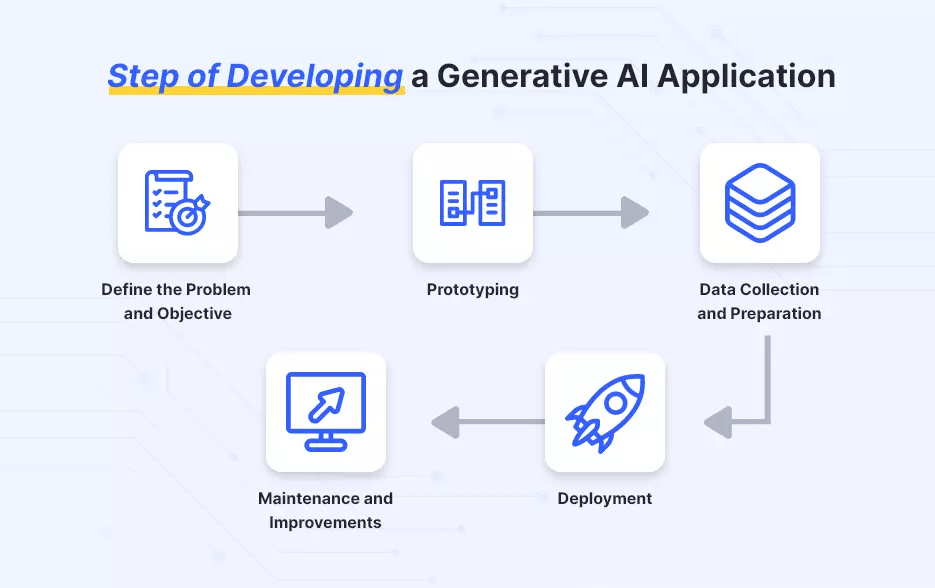
Now that we have a basic understanding of generative AI, let’s explore the steps involved in building a generative AI solution.
1. Define the Problem Statement
The first step in any AI project is to clearly define the problem statement and objectives. What type of content do you want to generate? Are you aiming to create realistic images, coherent text, or something else entirely? Identifying the scope and requirements of the project will guide your approach and help you choose the appropriate generative model.
2. Gather and Preprocess Data
Data is the lifeblood of any machine learning project, and generative AI is no exception. Start by collecting a diverse and representative dataset that aligns with your objectives. Whether it’s images, text corpora, or MIDI files, ensure that your dataset is clean, labeled (if applicable), and properly formatted. Preprocessing steps may include normalization, resizing, and data augmentation to enhance the quality and diversity of the data.
3. Choose a Generative Model
Once you have your data prepared, it’s time to select a generative model that best suits your needs. GANs are ideal for generating realistic images and videos, while VAEs are well-suited for tasks that require capturing the underlying structure of the data, such as generating text or music. Consider the strengths and limitations of each model and choose the one that aligns with your project goals.
4. Train the Model
Training a generative AI model can be computationally intensive and time-consuming, depending on the complexity of the task and the size of the dataset. Utilize hardware accelerators such as GPUs or TPUs to expedite the training process. Experiment with different hyperparameters, architectures, and optimization techniques to optimize the performance of your model. Monitor the training progress and evaluate the model’s performance using appropriate metrics and validation techniques.
5. Generate and Evaluate Samples
Once the model is trained, you can generate new samples by feeding random noise or latent vectors into the generator network. Evaluate the quality of the generated samples using both qualitative and quantitative metrics. For image generation tasks, visual inspection and perceptual similarity metrics such as Fréchet Inception Distance (FID) can help assess the realism and diversity of the generated images. Iterate on the model architecture and training process based on the feedback from sample generation and evaluation.
6. Deploy and Iterate
Finally, deploy your generative AI solution in a real-world environment and gather feedback from users and stakeholders. Monitor the performance of the deployed model and iterate on the design and implementation as needed. Continuously refine and improve your generative AI solution based on user feedback, emerging techniques, and advancements in the field.
Conclusion
Generative AI represents a fascinating frontier in artificial intelligence, enabling machines to exhibit creativity and imagination. By understanding the principles and techniques behind generative models such as GANs and VAEs, you can harness the power of AI to generate novel and compelling content across various domains. Whether you’re an artist, a researcher, or an entrepreneur, building generative AI solutions opens up a world of possibilities and unlocks new avenues for innovation and expression.
Now that you’ve gained insights into the process of building generative AI solutions, why not explore further by checking out this comprehensive guide on how to build a generative AI solution? Embark on your journey into the captivating world of generative AI and unleash your creativity like never before.
 FinTech blogs
Leave a comment