In the contemporary landscape of technological innovation, enterprises are continually seeking ways to optimize processes, enhance productivity, and deliver exceptional value to their customers. Amidst this quest, one paradigm has emerged as a game-changer: Generative AI Architecture. This groundbreaking approach to artificial intelligence has transcended traditional boundaries, offering enterprises unprecedented capabilities to generate, create, and innovate across various domains. In this article, we delve into the transformative potential of Generative AI Architecture and its implications for enterprises worldwide.
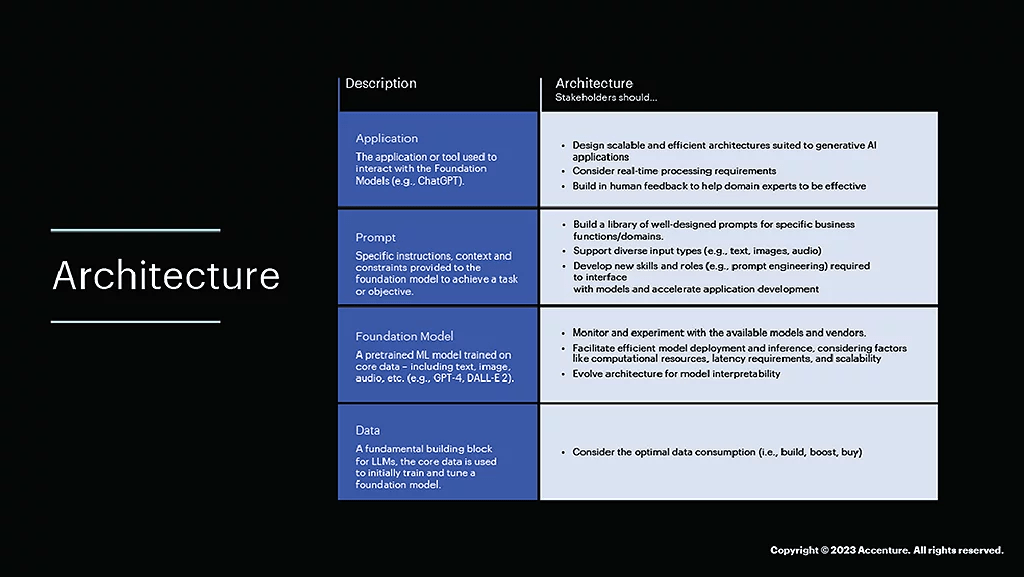
Generative AI Architecture represents a significant evolution in AI capabilities, enabling machines to not only comprehend and process data but also to generate new content, images, text, and even entire simulations autonomously. Unlike conventional AI systems that rely on predefined rules and patterns, generative models leverage advanced algorithms and neural networks to understand and mimic the underlying patterns of data, thereby fostering creativity and innovation. At the heart of Generative AI Architecture lies the ability to learn from vast datasets and autonomously produce content that exhibits human-like characteristics.
One of the key applications of Generative AI Architecture in enterprises is in the realm of content generation and augmentation. From marketing campaigns to product design, enterprises can leverage generative models to produce compelling content that resonates with their target audience. For instance, Generative AI can be employed to generate personalized marketing materials, design innovative product prototypes, or even create immersive virtual experiences for customers. By automating content creation processes, enterprises can streamline workflows, reduce costs, and accelerate time-to-market, thereby gaining a competitive edge in today’s fast-paced business environment.
Moreover, Generative AI Architecture holds immense potential in revolutionizing the field of creative industries such as art, music, and literature. Through generative models, enterprises can unlock new avenues of artistic expression, enabling machines to collaborate with human artists in the creation of multimedia artworks, musical compositions, and literary pieces. By harnessing the power of AI-driven creativity, enterprises can push the boundaries of innovation, foster interdisciplinary collaboration, and redefine the very nature of artistic expression in the digital age.
Another compelling application of Generative AI Architecture lies in the field of data synthesis and simulation. Enterprises can utilize generative models to generate synthetic data that closely resembles real-world datasets, thereby addressing the challenges of data scarcity and privacy concerns. By generating synthetic data, enterprises can augment their existing datasets, improve the performance of machine learning models, and mitigate the risks associated with sensitive data handling. Furthermore, Generative AI can be employed to simulate complex scenarios and environments, enabling enterprises to conduct virtual experiments, optimize processes, and make data-driven decisions with unprecedented accuracy and efficiency.
In addition to content generation and data synthesis, Generative AI Architecture holds promise in the realm of natural language processing and conversational AI. By leveraging generative models, enterprises can develop intelligent chatbots and virtual assistants capable of engaging in natural, human-like conversations with customers and employees. These AI-powered conversational interfaces can enhance customer service experiences, automate routine inquiries, and provide personalized recommendations, thereby driving customer satisfaction and loyalty. Moreover, Generative AI can be used to generate natural language text, automate document summarization, and even assist in content translation, empowering enterprises to break down language barriers and communicate effectively across diverse audiences and markets.
However, as enterprises embark on their journey to harness the power of Generative AI Architecture, they must also navigate a myriad of challenges and ethical considerations. One of the primary concerns surrounding generative models is the potential for bias and misinformation, as AI systems may inadvertently perpetuate or amplify existing societal biases present in the training data. To address this issue, enterprises must prioritize transparency, fairness, and accountability in the development and deployment of generative AI solutions, ensuring that these technologies are used responsibly and ethically.
Furthermore, enterprises must grapple with the complexities of data privacy and security when leveraging generative models for content generation and data synthesis. As generative AI systems become increasingly proficient at generating realistic and convincing content, there is a growing risk of misuse and manipulation, such as the creation of deepfakes or counterfeit documents. To mitigate these risks, enterprises must implement robust security measures, such as data encryption, access controls, and algorithmic auditing, to safeguard against unauthorized access and manipulation of generative AI systems.
In conclusion, Generative AI Architecture represents a paradigm shift in the capabilities of artificial intelligence, offering enterprises unprecedented opportunities to innovate, create, and transform across various domains. From content generation to data synthesis, from artistic expression to conversational AI, the potential applications of generative models are vast and diverse. However, as enterprises embrace the power of Generative AI, they must also remain vigilant and proactive in addressing the ethical, legal, and security implications associated with these transformative technologies. By doing so, enterprises can unlock the full potential of Generative AI Architecture and pave the way for a future of innovation and growth in the digital age.
 FinTech blogs
Leave a comment