The financial landscape is undergoing a significant transformation driven by rapid advancements in technology. Among these, artificial intelligence (AI) is emerging as a pivotal force, reshaping various sectors, including treasury management. AI in treasury management is not just a futuristic concept; it is a present-day reality offering immense potential to enhance efficiency, accuracy, and strategic decision-making. This article delves into the multifaceted impact of AI on treasury management, exploring its benefits, applications, and future prospects.
Understanding Treasury Management
Before delving into the impact of AI, it is essential to understand what treasury management entails. Treasury management involves overseeing a company’s financial assets and holdings to maximize liquidity, reduce financial risks, and ensure optimal utilization of cash resources. Key functions include cash and liquidity management, risk management, investment decision-making, and financial reporting. The complexity and critical nature of these tasks demand precision, timely information, and strategic foresight.
The Advent of AI in Treasury Management
AI in treasury management refers to the integration of advanced technologies, such as machine learning (ML), natural language processing (NLP), and robotic process automation (RPA), to streamline and enhance various treasury functions. These technologies enable the automation of routine tasks, provide deeper insights through data analysis, and support predictive analytics for better decision-making.
Automation and Efficiency
One of the most immediate benefits of AI in treasury management is automation. Repetitive and time-consuming tasks such as data entry, reconciliation, and reporting can be automated using RPA. This not only reduces the workload on treasury professionals but also minimizes errors associated with manual processes. AI-powered tools can swiftly process large volumes of transactions, ensuring accuracy and compliance with regulatory requirements.
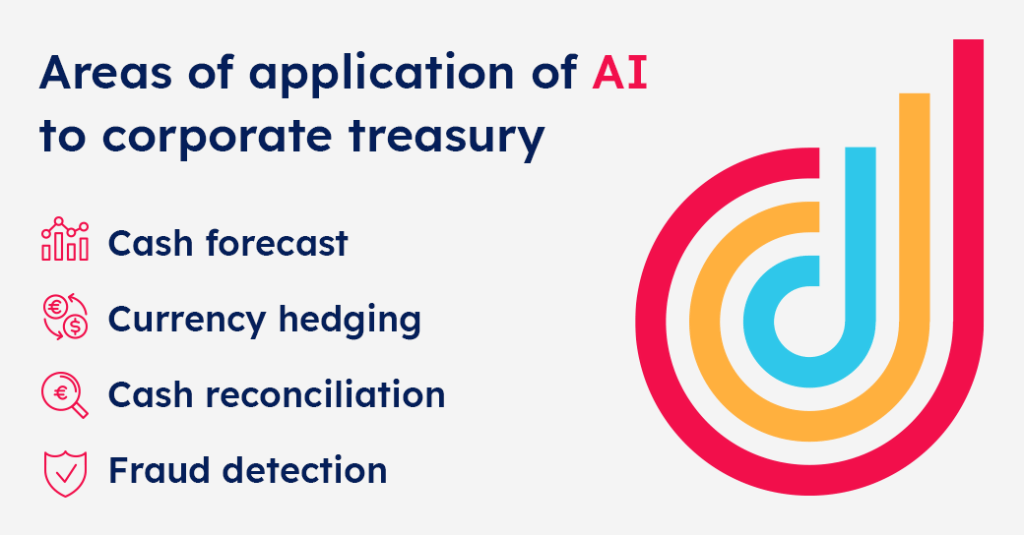
For instance, AI can automate the reconciliation process by matching invoices with payments, identifying discrepancies, and flagging them for further review. This leads to faster and more accurate financial reporting, enabling treasury teams to focus on strategic activities rather than operational chores.
Enhanced Cash Flow Forecasting
Accurate cash flow forecasting is crucial for effective treasury management. Traditional forecasting methods often rely on historical data and are prone to inaccuracies due to changing market conditions. AI enhances cash flow forecasting by analyzing vast datasets in real-time, identifying patterns, and predicting future cash flows with higher precision.
Machine learning algorithms can incorporate various factors such as market trends, economic indicators, and seasonal variations to generate more reliable forecasts. This enables treasurers to make informed decisions regarding investments, debt management, and liquidity planning, thereby optimizing the company’s financial position.
Risk Management and Mitigation
Risk management is a core aspect of treasury management, encompassing market risk, credit risk, and operational risk. AI in treasury management significantly improves risk management by providing advanced analytics and predictive capabilities. AI algorithms can analyze market data, monitor economic indicators, and assess geopolitical events to predict potential risks and their impact on the organization.
For example, AI can evaluate the creditworthiness of counterparties by analyzing their financial statements, credit history, and market behavior. This allows treasurers to make informed decisions on credit limits and avoid potential defaults. Additionally, AI-driven risk models can simulate various market scenarios, helping treasurers develop robust risk mitigation strategies.
Strategic Decision Support
AI in treasury management is not limited to operational efficiency; it also plays a critical role in strategic decision-making. By leveraging AI-powered analytics, treasurers can gain deeper insights into financial performance, market conditions, and investment opportunities. Natural language processing (NLP) tools can analyze news articles, financial reports, and social media trends to provide a comprehensive view of market sentiments.
Furthermore, AI can assist in portfolio management by recommending optimal investment strategies based on risk appetite and market conditions. These AI-driven insights enable treasurers to make data-backed decisions, enhancing the organization’s financial resilience and growth prospects.
Overcoming Challenges in AI Adoption
While the benefits of AI in treasury management are compelling, the adoption of AI technologies comes with its set of challenges. One of the primary concerns is data security and privacy. Treasury management involves handling sensitive financial information, and ensuring the security of this data is paramount. Organizations must invest in robust cybersecurity measures to protect against data breaches and cyber threats.
Another challenge is the integration of AI with existing systems. Many organizations operate on legacy systems that may not be compatible with modern AI solutions. This requires significant investment in technology infrastructure and skilled personnel to manage and maintain these systems.
Moreover, the success of AI in treasury management depends on the quality of data. Inaccurate or incomplete data can lead to erroneous predictions and decisions. Therefore, organizations must establish strong data governance practices to ensure the accuracy and integrity of their data.
The Future of AI in Treasury Management
The future of AI in treasury management looks promising, with continuous advancements in technology paving the way for more sophisticated applications. As AI algorithms become more advanced, they will offer even greater predictive accuracy and deeper insights. The integration of AI with other emerging technologies like blockchain and the Internet of Things (IoT) could further revolutionize treasury operations.
Blockchain technology can enhance the transparency and security of financial transactions, while IoT can provide real-time data on physical assets, improving asset management and financial planning. The convergence of these technologies will create a more connected and efficient treasury ecosystem.
Additionally, AI will continue to evolve in its ability to understand and interpret unstructured data, such as text and images, through advanced NLP and computer vision technologies. This will open new avenues for analyzing financial documents, contracts, and communications, providing treasurers with a holistic view of their financial environment.
Conclusion
AI in treasury management is transforming the way organizations manage their financial assets and risks. By automating routine tasks, enhancing cash flow forecasting, improving risk management, and supporting strategic decision-making, AI offers a comprehensive solution to the challenges faced by modern treasuries. Despite the challenges in adoption, the potential benefits far outweigh the hurdles, making AI an indispensable tool in the arsenal of treasury professionals.
As technology continues to advance, the role of AI in treasury management will only grow, driving efficiency, accuracy, and strategic foresight. Organizations that embrace AI will be better positioned to navigate the complexities of the financial landscape and achieve sustained growth and stability.
 FinTech blogs
Leave a comment