The financial industry has always been at the forefront of adopting cutting-edge technologies to improve efficiency, accuracy, and customer satisfaction. One of the most transformative technologies in recent years is Generative AI. Generative AI in finance is reshaping how institutions operate, analyze data, and serve their clients. This article explores the various applications, benefits, and future potential of Generative AI in the finance sector.
What is Generative AI?
Generative AI refers to a subset of artificial intelligence that can generate new content, such as text, images, and even complex data structures, based on the patterns it has learned from existing data. Unlike traditional AI, which primarily focuses on classification and prediction, Generative AI creates new possibilities and solutions, making it particularly valuable for dynamic and innovative fields like finance.
Applications of Generative AI in Finance
1. Risk Management
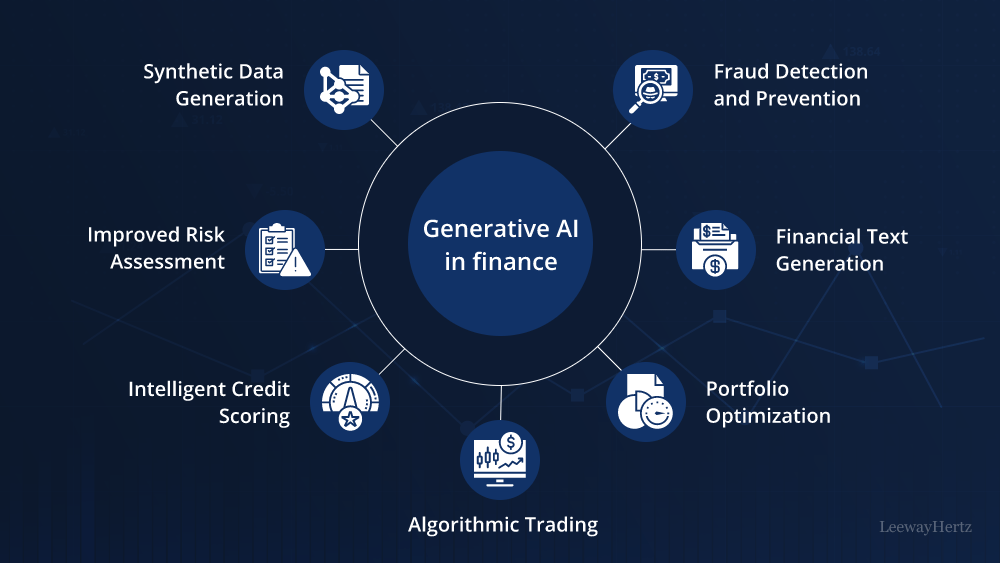
Risk management is a critical aspect of finance, where predicting and mitigating risks can save institutions from significant losses. Generative AI helps by simulating various market conditions and generating potential risk scenarios. This allows financial institutions to prepare and develop strategies for worst-case scenarios. By creating synthetic data that mimics real-world events, Generative AI provides a deeper understanding of potential risks and their impacts.
2. Fraud Detection
Fraudulent activities are a constant threat to financial institutions. Traditional methods of fraud detection often rely on predefined rules and historical data. Generative AI, however, can learn from a vast array of data points and detect anomalies that may indicate fraudulent behavior. By continuously generating new models and scenarios, Generative AI enhances the ability to identify and prevent fraud in real-time.
3. Personalized Financial Services
In today’s competitive market, personalized customer service is essential. Generative AI enables financial institutions to offer tailored services by analyzing individual customer data and generating personalized recommendations. Whether it’s investment advice, loan offers, or savings plans, Generative AI can create customized solutions that meet the unique needs of each customer, enhancing satisfaction and loyalty.
4. Algorithmic Trading
Algorithmic trading involves using complex algorithms to execute trades at optimal times. Generative AI can improve these algorithms by generating new trading strategies based on historical data and current market conditions. This leads to more efficient and profitable trading decisions. Additionally, Generative AI can simulate market scenarios to test the robustness of trading strategies before they are deployed in real markets.
5. Financial Forecasting
Accurate forecasting is crucial for financial planning and decision-making. Generative AI enhances forecasting by generating more precise and nuanced predictions. It can analyze vast amounts of data, identify trends, and generate forecasts that account for various factors and potential market changes. This leads to better-informed decisions and improved financial performance.
Benefits of Generative AI in Finance
Improved Efficiency
Generative AI automates complex tasks, reducing the time and effort required by human analysts. This leads to increased efficiency and allows financial professionals to focus on higher-value activities.
Enhanced Accuracy
By leveraging vast amounts of data and generating new insights, Generative AI improves the accuracy of financial analyses and predictions. This reduces errors and enhances the reliability of financial decisions.
Cost Savings
Automation and improved accuracy lead to significant cost savings. Financial institutions can reduce operational costs, minimize losses due to fraud or poor investment decisions, and optimize resource allocation.
Innovation and Competitiveness
Generative AI fosters innovation by enabling financial institutions to develop new products and services. This keeps them competitive in a rapidly evolving market and meets the changing demands of customers.
Challenges and Considerations
Data Privacy and Security
The use of Generative AI in finance requires access to vast amounts of sensitive data. Ensuring data privacy and security is paramount. Financial institutions must implement robust measures to protect customer data and comply with regulatory requirements.
Ethical Concerns
Generative AI can potentially create scenarios that raise ethical questions. For instance, the generation of synthetic data must be handled carefully to avoid misuse. Financial institutions must establish ethical guidelines for the use of Generative AI.
Integration with Existing Systems
Integrating Generative AI into existing financial systems can be challenging. Institutions need to invest in infrastructure and training to ensure seamless integration and effective use of AI technologies.
The Future of Generative AI in Finance
The future of Generative AI in finance is promising. As the technology continues to evolve, we can expect even more sophisticated applications and greater integration into financial operations. Future developments may include:
Advanced Risk Modeling
Generative AI will likely develop more advanced risk modeling techniques, providing even deeper insights and more effective risk mitigation strategies.
Real-Time Personalization
The ability to provide real-time personalized financial services will become more refined, offering customers immediate and highly relevant advice and solutions.
Autonomous Financial Operations
With advancements in AI, we may see the rise of fully autonomous financial operations, where AI handles everything from trading to customer service without human intervention.
Conclusion
Generative AI in finance is transforming the industry by enhancing risk management, fraud detection, personalized services, algorithmic trading, and financial forecasting. The benefits of improved efficiency, accuracy, cost savings, and innovation are substantial. However, challenges such as data privacy, ethical concerns, and integration must be addressed. As we look to the future, Generative AI promises to drive even greater advancements and reshape the financial landscape.
Read More: https://www.leewayhertz.com/generative-ai-platform-for-finance/
 FinTech blogs
Leave a comment