Introduction
In recent years, Generative AI has emerged as a transformative technology, reshaping industries from art and entertainment to healthcare and finance. At the heart of this innovation lies the Generative AI tech stack, a powerful ensemble of technologies and frameworks that enable machines to create content autonomously. This article delves into the components of the Generative AI tech stack, its applications, and its impact on various sectors.
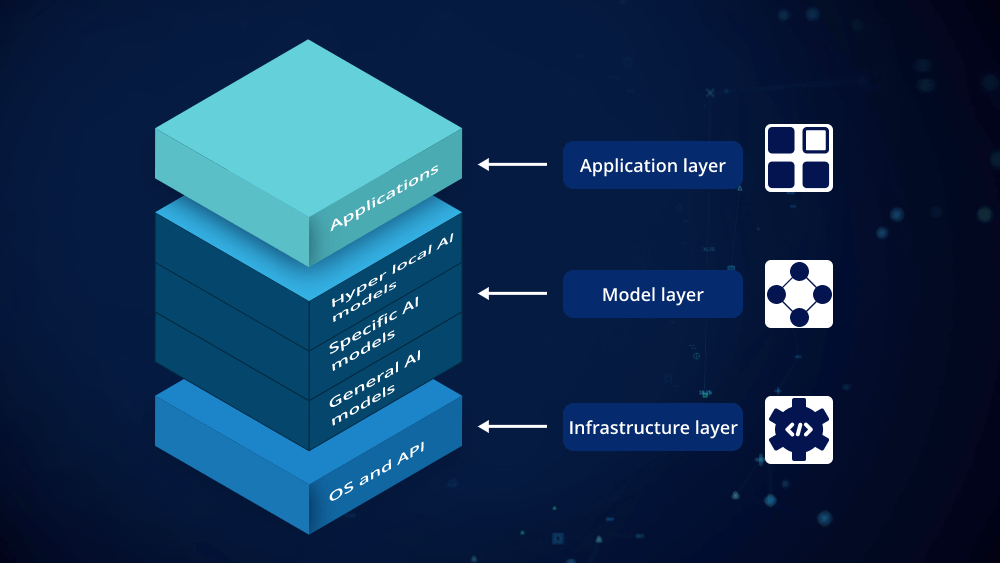
Understanding Generative AI
Generative AI refers to algorithms and models capable of generating new content, whether it’s images, text, music, or even entire pieces of software code. Unlike traditional AI systems that are rule-based or trained on specific datasets, generative models can create content independently, often mimicking human creativity.
Key Components of the Generative AI Tech Stack
- Neural Networks: At the core of Generative AI are neural networks, particularly deep learning models like Generative Adversarial Networks (GANs) and Variational Autoencoders (VAEs). These networks are trained on vast datasets to learn patterns and generate new content based on learned features.
- Natural Language Processing (NLP): For text generation tasks, NLP techniques play a crucial role. Models such as OpenAI’s GPT (Generative Pre-trained Transformer) utilize transformer architectures to understand and generate human-like text.
- Computer Vision: In visual content generation, computer vision models are employed. Convolutional Neural Networks (CNNs) are commonly used to understand visual data and generate images or videos that are realistic and novel.
- Reinforcement Learning: Some advanced generative models incorporate reinforcement learning techniques, where the model learns through trial and error to optimize its outputs based on feedback from the environment or users.
- Data Pipelines and Preprocessing: Handling large datasets efficiently is essential in training generative models. Data pipelines and preprocessing tools ensure that data is cleaned, normalized, and ready for training, optimizing the performance and accuracy of generative models.
Applications Across Industries
Generative AI’s versatility allows it to be applied across diverse sectors:
- Art and Creativity: Artists use generative models to explore new styles and create unique artworks.
- Entertainment: From generating scripts to enhancing special effects in movies, generative AI is revolutionizing the entertainment industry.
- Healthcare: Generative models assist in medical image analysis, drug discovery, and even personalized patient care.
- Finance: In finance, AI-generated predictions help in portfolio management and risk assessment.
Challenges and Future Directions
Despite its promise, the Generative AI tech stack faces several challenges:
- Ethical Concerns: Issues surrounding data privacy, bias in generated content, and misuse of AI-generated materials are significant concerns.
- Complexity and Computational Resources: Training advanced generative models requires substantial computational resources and expertise.
- Interpreting and Controlling Outputs: Ensuring that generated content meets desired criteria and can be controlled remains a challenge.
Impact on Society
The widespread adoption of Generative AI tech stack is poised to bring profound societal changes:
- Job Transformations: Automation of creative tasks could reshape job markets, requiring new skill sets.
- Enhanced Creativity: Generative AI tools empower individuals and industries to explore new creative frontiers.
- Accessible Innovation: By democratizing creativity, AI makes sophisticated tools accessible to a broader audience.
Conclusion
The Generative AI tech stack represents a leap forward in technology, enabling machines to exhibit creativity and innovation previously attributed solely to humans. As research and development in this field continue to advance, the applications and impacts of generative models will likely expand, reshaping industries and societies worldwide. Embracing this technology responsibly ensures that its benefits are maximized while addressing ethical and practical challenges for a sustainable future.
Read More: https://www.leewayhertz.com/generative-ai-tech-stack/
 FinTech blogs
Leave a comment