Generative AI is transforming industries by creating content, designing products, and solving complex problems. If you’re interested in understanding how to build a generative AI solution, this guide will walk you through the essential steps to develop a successful AI model. By the end, you’ll have a clear roadmap for creating your own generative AI project.
Understanding Generative AI
Before diving into how to build a generative AI solution, it’s crucial to understand what generative AI is. Generative AI refers to algorithms that can generate new content, such as text, images, or even music, by learning from existing data. Unlike traditional AI models that simply classify or predict, generative AI creates new, unique outputs based on patterns it has learned.
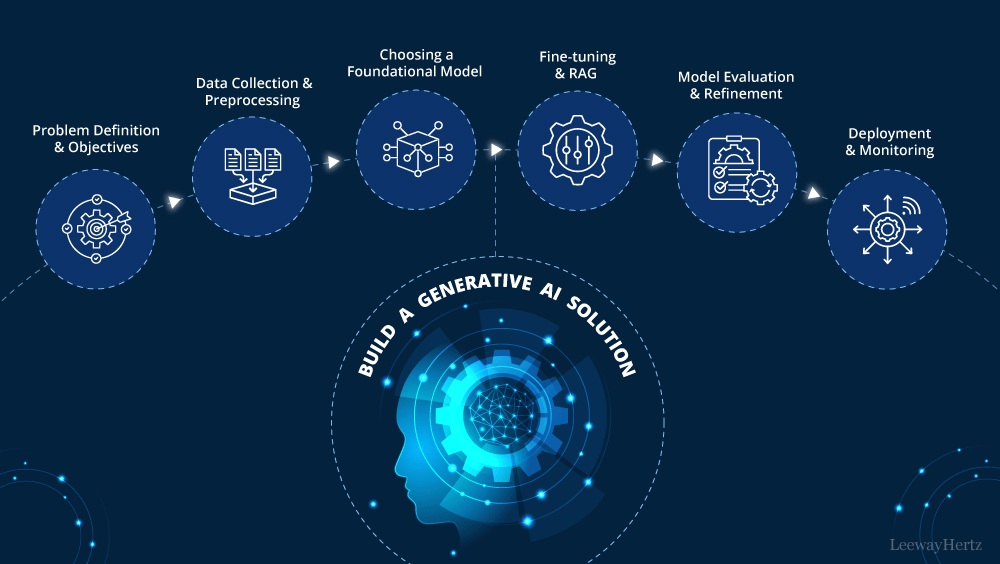
Step 1: Define Your Objective
The first step in how to build a generative AI solution is to clearly define your objectives. What type of content do you want your AI to generate? Common applications include:
- Text Generation: Creating articles, poetry, or dialogue.
- Image Generation: Producing artwork or synthetic images.
- Music Generation: Composing new music or sound effects.
By defining your objective, you can tailor your approach and select the right tools and techniques for your project.
Step 2: Gather and Prepare Data
Data is the foundation of any generative AI solution. The quality and quantity of your data will significantly impact the performance of your model. Here’s how to prepare your data:
- Collect Data: Gather a large dataset relevant to your objective. For instance, if you’re building a text generator, you’ll need a diverse collection of text documents.
- Clean Data: Remove any irrelevant or noisy data. Ensure that your dataset is consistent and formatted correctly.
- Preprocess Data: Depending on the type of data, preprocessing might involve tokenization for text or resizing for images.
Step 3: Choose the Right Model
Selecting the right model is crucial in how to build a generative AI solution. Different models are suited for different types of generative tasks. Here are some popular choices:
- Generative Adversarial Networks (GANs): Excellent for generating realistic images and videos. GANs consist of two neural networks—the generator and the discriminator—that work against each other to create high-quality outputs.
- Variational Autoencoders (VAEs): Useful for generating images and learning latent representations of data. VAEs are particularly good at generating diverse and coherent outputs.
- Transformers: Ideal for text generation tasks. Transformers, like GPT (Generative Pre-trained Transformer), are capable of producing coherent and contextually relevant text.
Step 4: Train Your Model
Training is a critical phase in how to build a generative AI solution. This involves feeding your data into the model and adjusting its parameters to minimize errors. Here’s a simplified process:
- Split Data: Divide your data into training, validation, and test sets to evaluate the performance of your model.
- Configure Hyperparameters: Set parameters like learning rate, batch size, and the number of epochs based on your model and data.
- Monitor Training: Track the model’s performance using metrics such as loss and accuracy. Use validation data to ensure that the model is not overfitting.
Step 5: Evaluate and Refine Your Model
Once your model is trained, it’s time to evaluate its performance. This step involves:
- Testing the Model: Use your test dataset to assess how well your model generates content. Check for accuracy, coherence, and creativity depending on your objective.
- Refining the Model: Based on the evaluation, make adjustments to improve performance. This might involve fine-tuning hyperparameters, augmenting data, or modifying the model architecture.
Step 6: Deploy Your Generative AI Solution
With a trained and refined model, you can now deploy your generative AI solution. Deployment involves integrating your model into a user-friendly application or service. Consider the following:
- Develop an Interface: Create an application or platform where users can interact with your generative AI. For example, a web app for text generation or a mobile app for image creation.
- Ensure Scalability: Design your deployment infrastructure to handle varying loads. Cloud services can provide scalability and flexibility.
- Monitor Performance: Continuously monitor the deployed model to ensure it performs well and make updates as needed.
Step 7: Iterate and Improve
Building a generative AI solution is not a one-time process. It’s essential to iterate and improve continuously. Collect user feedback, analyze performance metrics, and make necessary adjustments to enhance the model’s capabilities and output quality.
Conclusion
Learning how to build a generative AI solution involves several key steps, from defining your objectives and preparing data to choosing the right model and deploying it. By following this guide, you can develop a powerful generative AI system tailored to your specific needs. Remember, the field of generative AI is constantly evolving, so stay updated with the latest advancements to keep your solution at the cutting edge.
 FinTech blogs
Leave a comment