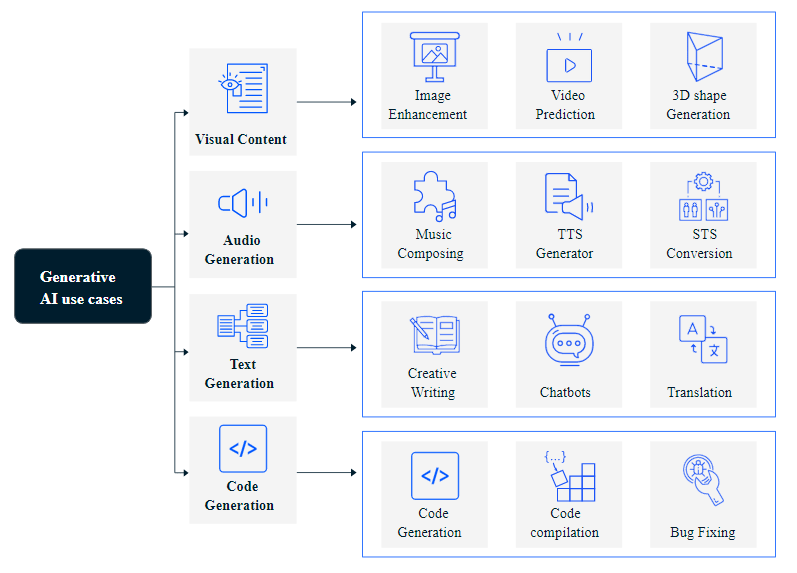
Generative AI has emerged as a groundbreaking technology, transforming various industries with its ability to create new content, optimize processes, and enhance decision-making. This article delves into the diverse Generative AI use cases, explores its applications across different sectors, discusses innovative solutions it offers, and outlines key steps for successful implementation.
Understanding Generative AI
Generative AI refers to a subset of artificial intelligence that involves algorithms designed to generate new data, such as text, images, audio, or even complex designs, based on patterns learned from existing data. Unlike traditional AI, which focuses on analyzing and interpreting data, Generative AI creates new content, making it a powerful tool for innovation and creativity.
Generative AI Use Cases
Content Creation
One of the most prominent Generative AI use cases is in content creation. Tools like GPT-4, DALL-E, and others have revolutionized how content is generated. Writers, marketers, and designers can now leverage Generative AI to produce high-quality articles, social media posts, graphics, and videos, saving time and enhancing productivity.
Healthcare
In healthcare, Generative AI use cases include drug discovery, personalized treatment plans, and medical imaging. AI algorithms can generate potential drug compounds, design patient-specific treatment protocols, and enhance the accuracy of diagnostic imaging, leading to improved patient outcomes.
Gaming and Entertainment
The gaming and entertainment industry has seen a surge in Generative AI use cases. AI can create realistic game environments, characters, and narratives, providing a more immersive experience for players. In the film industry, AI-generated special effects and scripts are becoming increasingly common.
Generative AI Applications
Marketing and Advertising
Generative AI applications in marketing and advertising are transforming how campaigns are developed and executed. AI can generate personalized content for target audiences, optimize ad placements, and create compelling visuals, leading to higher engagement and conversion rates.
Finance
In the financial sector, Generative AI applications include fraud detection, risk assessment, and algorithmic trading. AI systems can generate predictive models to identify fraudulent activities, assess credit risks, and develop trading strategies, ensuring more secure and efficient financial operations.
Education
Educational institutions are leveraging Generative AI applications to enhance learning experiences. AI can create personalized learning materials, generate practice questions, and even develop virtual tutors, making education more accessible and effective for students.
Generative AI Solutions
Natural Language Processing (NLP)
Generative AI solutions in NLP enable machines to understand, generate, and respond to human language with remarkable accuracy. These solutions are used in chatbots, virtual assistants, and automated customer service systems, providing seamless and efficient communication.
Image and Video Generation
Generative AI solutions for image and video generation are used in various fields, from entertainment to security. AI can create realistic images and videos, generate deepfakes, and enhance visual content for marketing and advertising campaigns.
Data Augmentation
Data augmentation is another key Generative AI solution. By generating synthetic data, AI can help improve the training of machine learning models, especially when real-world data is scarce or biased. This leads to more robust and accurate AI systems.
Generative AI Implementation
Defining Objectives
The first step in Generative AI implementation is to define clear objectives. Understand what you want to achieve with AI, whether it’s automating content creation, enhancing customer service, or improving data analysis. Clear goals will guide the development and deployment process.
Data Collection and Preparation
Data is the backbone of Generative AI. Collect and prepare high-quality data relevant to your objectives. Ensure that the data is clean, diverse, and representative of the real-world scenarios where the AI will be applied. This step is crucial for training accurate and reliable AI models.
Choosing the Right Tools and Platforms
Select the appropriate tools and platforms for your Generative AI implementation. There are various AI frameworks and libraries available, such as TensorFlow, PyTorch, and OpenAI’s GPT-4, each offering unique features and capabilities. Choose the one that best fits your needs and expertise.
Model Training and Testing
Train your Generative AI models using the prepared data. Monitor the training process to ensure the model is learning correctly and make adjustments as needed. After training, rigorously test the model to evaluate its performance and accuracy. This step helps identify any issues and ensures the model is ready for deployment.
Deployment and Monitoring
Once the model is trained and tested, deploy it into the production environment. Continuously monitor the model’s performance and gather feedback to make necessary improvements. Regular updates and maintenance are essential to keep the AI system effective and relevant.
Conclusion
Generative AI is revolutionizing numerous industries with its innovative use cases, diverse applications, and effective solutions. By understanding the potential of Generative AI and following a structured implementation process, organizations can harness its power to drive innovation, improve efficiency, and achieve their strategic goals. As this technology continues to evolve, its impact will only grow, opening up new possibilities for businesses and individuals alike.
 FinTech blogs
Leave a comment