Building a generative AI solution can seem like a daunting task, but with the right approach, you can create a powerful tool that generates creative content, solves problems, and adds value to various industries. This guide will walk you through the essential steps to develop your generative AI, ensuring you understand the process from start to finish.
Understanding Generative AI
Before diving into the steps on how to build a generative AI solution, it’s crucial to understand what generative AI is. Generative AI refers to a class of artificial intelligence algorithms that can create new content based on the data they have been trained on. This includes text, images, music, and even code. The most well-known example of generative AI is OpenAI’s GPT, which can generate human-like text based on a given prompt.
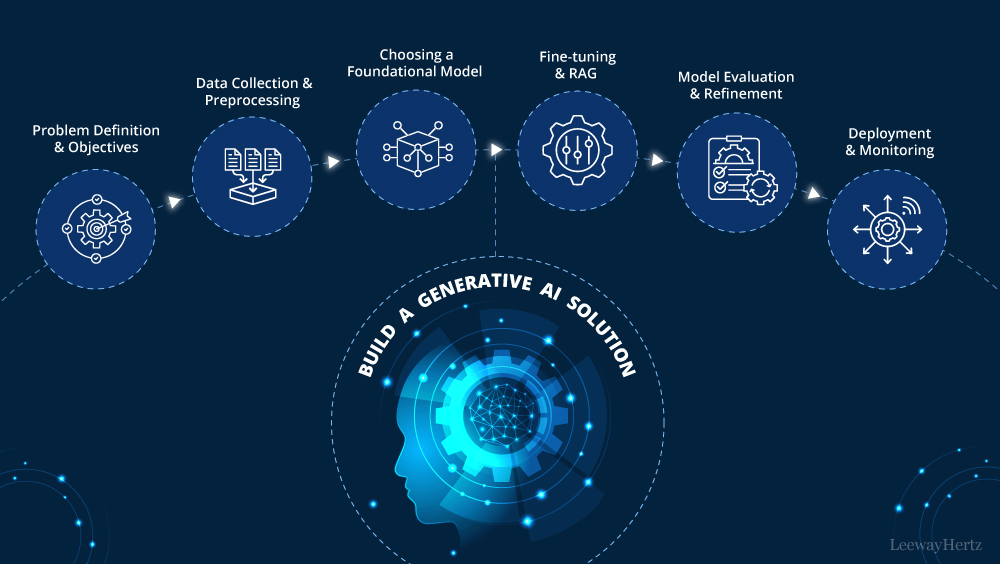
Step 1: Define the Problem and Objectives
The first step in building a generative AI solution is to define the problem you want to solve. What kind of content do you want your AI to generate? Are you looking to create realistic images, generate text for marketing purposes, or compose music? Defining the problem and setting clear objectives will help guide the development process.
Step 2: Choose the Right Model
Once you have a clear understanding of your goals, the next step is to choose the appropriate model for your generative AI solution. There are several models available, each suited for different tasks. For example, if you want to generate text, models like GPT-4 are highly effective. If your goal is to create images, you might consider using a Generative Adversarial Network (GAN) or diffusion models.
Selecting the right model is crucial in how to build a generative AI solution that meets your needs. You must also consider factors like the complexity of the model, the amount of data required, and the computational resources at your disposal.
Step 3: Gather and Prepare Data
Data is the backbone of any AI system, and this is especially true when learning how to build a generative AI solution. You’ll need to gather a large dataset that is relevant to the task your AI will perform. For instance, if you’re building a text generator, you’ll need a substantial corpus of text. If you’re creating an image generator, you’ll need a vast collection of images.
Once you’ve gathered the data, you must clean and preprocess it. This involves removing any irrelevant or incorrect data, normalizing the data, and possibly augmenting it to improve the model’s performance. The quality of your data will directly impact the effectiveness of your generative AI solution.
Step 4: Train the Model
Training the model is one of the most critical steps in how to build a generative AI solution. During this process, your model learns from the data you’ve provided. Depending on the complexity of the model and the size of your dataset, training can take anywhere from a few hours to several weeks.
You’ll need to monitor the training process closely, adjusting hyperparameters and ensuring the model is not overfitting or underfitting the data. Tools like TensorFlow or PyTorch are commonly used for training AI models and offer various utilities to help streamline the process.
Step 5: Evaluate and Fine-Tune the Model
Once training is complete, the next step in how to build a generative AI solution is to evaluate the model’s performance. You can do this by running the model on a separate test dataset that it has not seen before. Evaluate the output based on specific criteria relevant to your goals, such as accuracy, creativity, or realism.
If the model’s performance is not up to par, you may need to fine-tune it. Fine-tuning involves adjusting the model’s parameters, adding more data, or modifying the model’s architecture to improve performance.
Step 6: Deploy the Model
After fine-tuning, the next step in how to build a generative AI solution is deployment. Deploying your model allows you to integrate it into your application or service so that end users can interact with it. Deployment can be done on cloud platforms like AWS, Google Cloud, or Azure, depending on your infrastructure.
It’s important to ensure your model runs efficiently in a production environment. This may involve optimizing the model to reduce latency, improving scalability, and implementing monitoring systems to track performance.
Step 7: Monitor and Maintain the Solution
The final step in how to build a generative AI solution is ongoing monitoring and maintenance. AI models can degrade over time as new data becomes available or as user interactions evolve. Regularly updating the model with new data and fine-tuning it as necessary will help maintain its performance.
Monitoring also involves keeping an eye on how users are interacting with the AI and making adjustments based on feedback. This continuous improvement process ensures your generative AI solution remains relevant and effective over time.
Conclusion
Building a generative AI solution is a complex yet rewarding process that involves several critical steps, from defining your problem to monitoring the deployed model. By following these steps on how to build a generative AI solution, you can create a powerful tool that meets your specific needs. With careful planning, data preparation, and model selection, you can harness the power of generative AI to create innovative and valuable solutions.
 FinTech blogs
Leave a comment