In the rapidly evolving landscape of artificial intelligence (AI), the advent of Advanced Retrieval-Augmented Generation (Advanced RAG) is shaping how machines understand and generate human-like text. This article explores the architecture, techniques, applications, and use cases of Advanced RAG, providing a clear, easy-to-understand overview of this cutting-edge technology. By diving into its components, capabilities, and real-world implementations, we aim to illuminate the potential of Advanced RAG in transforming AI-driven text generation.
What is Advanced RAG?
Advanced Retrieval-Augmented Generation (Advanced RAG) is an AI model that enhances traditional text generation by integrating information retrieval mechanisms. Unlike conventional models that rely solely on pre-trained data, Advanced RAG dynamically retrieves relevant data from external sources, augmenting its responses with up-to-date, contextually relevant information. This hybrid approach leads to more accurate, informative, and contextually appropriate outputs, making it an ideal tool for various AI applications.
Architecture of Advanced RAG
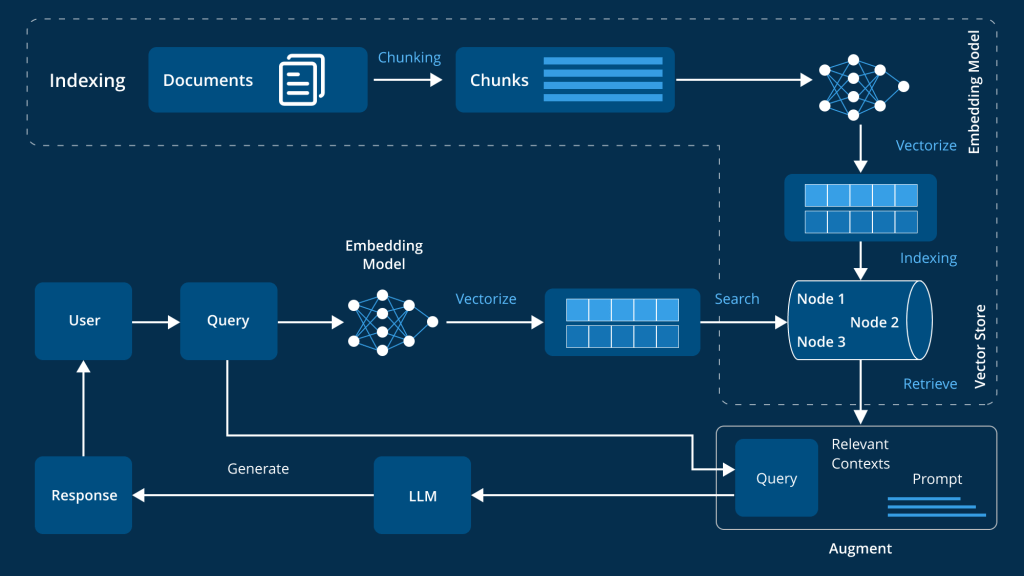
The architecture of Advanced RAG is built upon the synergy of two core components: a retriever and a generator.
- Retriever: The retriever’s role in Advanced RAG is to search a vast corpus of documents or data sources to find the most relevant information based on the input query. This component uses sophisticated algorithms, such as dense retrieval techniques, to ensure that the retrieved documents are highly relevant and contextually aligned with the query.
- Generator: Once the retriever has gathered the relevant information, the generator takes over. This component uses advanced natural language processing (NLP) techniques to synthesize the retrieved data into coherent, human-like text. By leveraging the latest developments in transformer-based models, the generator can produce text that is not only informative but also contextually nuanced.
The interaction between the retriever and generator in Advanced RAG enables the system to provide detailed, accurate, and contextually enriched responses. This architecture is particularly advantageous in scenarios where up-to-date information or specialized knowledge is required, such as in customer support, legal advice, or scientific research.
Techniques in Advanced RAG
Advanced RAG employs several cutting-edge techniques to enhance the quality and relevance of its outputs:
- Dense Retrieval: Unlike traditional keyword-based retrieval methods, dense retrieval leverages deep learning models to capture semantic similarities between queries and documents. This technique allows the retriever to find information that is contextually related, even if the exact keywords are not present.
- Knowledge Distillation: To improve efficiency, Advanced RAG often uses knowledge distillation, where a larger, more complex model (teacher) transfers its knowledge to a smaller, more efficient model (student). This process retains the performance of the larger model while reducing computational costs.
- Contextual Embedding: Contextual embeddings are a key technique in Advanced RAG, allowing the model to understand and generate text based on the context in which words and phrases appear. This leads to more accurate and relevant text generation.
- Iterative Refinement: In some implementations, Advanced RAG uses iterative refinement, where the generator’s output is fed back into the retriever to further refine the search and improve the final text. This loop ensures that the generated content is as relevant and precise as possible.
Applications of Advanced RAG
The versatility of Advanced RAG makes it suitable for a wide range of applications across various industries:
- Customer Support: Advanced RAG can be used to power AI-driven customer support systems that provide accurate and timely responses to customer queries. By retrieving the most relevant information from a company’s knowledge base or the web, the system can offer solutions that are both precise and contextually appropriate.
- Healthcare: In the healthcare industry, Advanced RAG can assist medical professionals by retrieving and synthesizing the latest research findings, clinical guidelines, and patient data to support decision-making. This can be particularly useful in diagnosing complex cases or providing personalized treatment recommendations.
- Legal Services: Legal professionals can leverage Advanced RAG to quickly access relevant case law, statutes, and legal opinions. The system can retrieve pertinent legal documents and generate summaries or analyses, streamlining the legal research process.
- Education: In educational settings, Advanced RAG can serve as an intelligent tutor, helping students by providing detailed explanations and answers to complex questions. It can also be used to create personalized learning materials based on a student’s specific needs and learning pace.
Use Cases of Advanced RAG
The implementation of Advanced RAG in real-world scenarios showcases its potential to revolutionize various domains:
- Interactive Chatbots: Companies can deploy Advanced RAG-powered chatbots that provide users with highly accurate and contextually relevant responses. This is particularly useful in industries like e-commerce, where customers seek detailed product information before making a purchase.
- Content Creation: Content creators can use Advanced RAG to generate high-quality articles, reports, or creative content by retrieving and synthesizing information from diverse sources. This can significantly reduce the time and effort required to produce comprehensive and informative content.
- Scientific Research: Researchers can benefit from Advanced RAG by accessing the latest studies, datasets, and publications relevant to their field. The model can retrieve and present this information in a structured format, aiding in literature reviews or the generation of new hypotheses.
- Financial Analysis: In the finance industry, Advanced RAG can be used to analyze vast amounts of financial data, news articles, and market trends. By retrieving and synthesizing relevant information, the system can provide insights that inform investment strategies and risk management.
Conclusion
Advanced RAG represents a significant advancement in AI-driven text generation, combining the strengths of retrieval and generation to produce highly accurate and contextually relevant content. Its architecture, which integrates a sophisticated retriever and a powerful generator, is the foundation for its success across various applications. From customer support to scientific research, the use cases of Advanced RAG demonstrate its transformative potential. As the technology continues to evolve, it is poised to play an increasingly important role in how we interact with and benefit from AI.
 FinTech blogs
Leave a comment