In today’s digital world, data is generated at an unprecedented rate, making it crucial for businesses and organizations to detect unusual patterns or behaviors that might indicate a problem. This process, known as anomaly detection, plays a significant role in various sectors, from finance to healthcare. AI in anomaly detection has emerged as a powerful tool, offering improved accuracy, speed, and efficiency in identifying these irregularities.
Understanding Anomaly Detection
Anomaly detection involves identifying data points, events, or patterns that deviate from the expected norm. These anomalies can signal critical issues such as fraud, cybersecurity threats, equipment malfunctions, or even health abnormalities. Traditional methods of anomaly detection often relied on statistical models or manual inspections, which are time-consuming and prone to human error. AI in anomaly detection has changed this landscape by automating the process and making it more reliable.
How AI in Anomaly Detection Works
AI in anomaly detection leverages machine learning algorithms, deep learning techniques, and data mining to automatically identify irregularities in large datasets. Here’s a look at how AI enhances anomaly detection:
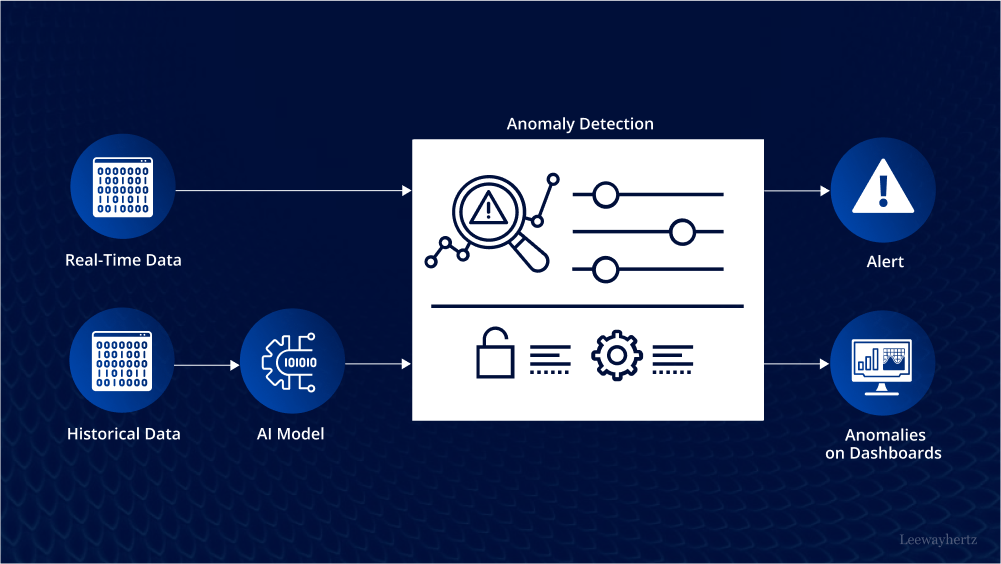
- Data Collection and Preprocessing: AI systems gather vast amounts of data from various sources, including sensors, logs, and user activities. This data is then cleaned and processed to remove noise and ensure it is ready for analysis.
- Model Training: Machine learning models are trained using historical data to recognize normal patterns and behaviors. These models learn the underlying structure of the data, enabling them to identify deviations that may indicate anomalies.
- Real-time Monitoring: AI-powered anomaly detection systems can monitor data in real-time, instantly flagging irregularities as they occur. This real-time capability is especially valuable in sectors like finance, where detecting fraud instantly can prevent significant losses.
- Adaptive Learning: Unlike traditional methods, AI in anomaly detection continuously learns from new data. This adaptive learning allows the system to refine its understanding of normal patterns and improve its accuracy in detecting anomalies over time.
Applications of AI in Anomaly Detection
AI in anomaly detection is transforming various industries by providing more accurate and timely insights into unusual activities. Some key applications include:
- Cybersecurity: One of the most prominent uses of AI in anomaly detection is in cybersecurity. AI models can detect unusual network traffic, unauthorized access attempts, or malicious activities that traditional security measures might miss. This proactive approach helps in preventing cyberattacks and data breaches.
- Fraud Detection: In finance, AI-driven anomaly detection is used to spot fraudulent transactions, unusual spending patterns, or suspicious account activities. Banks and financial institutions rely on these systems to protect their customers and reduce the risk of financial loss.
- Healthcare: AI in anomaly detection is being used in healthcare to identify irregular patient data, such as unusual heart rates, blood pressure, or symptoms that may indicate a medical emergency. This technology enables early intervention, improving patient outcomes and saving lives.
- Manufacturing and Maintenance: AI helps detect equipment malfunctions or deviations in manufacturing processes, which can lead to costly downtime or product defects. Predictive maintenance, powered by AI, identifies potential failures before they occur, optimizing operations and reducing costs.
- Retail and Customer Insights: Retailers use AI in anomaly detection to analyze customer behavior, identify unusual purchasing patterns, and optimize inventory management. This helps businesses tailor their offerings and improve the customer experience.
Benefits of AI in Anomaly Detection
AI in anomaly detection offers numerous advantages that traditional methods cannot match:
- Higher Accuracy: AI models are highly effective at distinguishing between normal and abnormal patterns, reducing the number of false positives and missed detections.
- Scalability: AI can handle vast amounts of data, making it suitable for large-scale applications where traditional methods would struggle.
- Speed: AI-powered systems can analyze data and detect anomalies in real-time, allowing for immediate action and reducing the impact of potential issues.
- Reduced Costs: By automating the anomaly detection process, AI reduces the need for manual intervention, saving time and resources.
- Continuous Improvement: AI models learn and adapt over time, improving their detection capabilities as they are exposed to new data.
Challenges and Future of AI in Anomaly Detection
Despite its many benefits, there are challenges associated with AI in anomaly detection. One significant challenge is the need for high-quality data, as poor data can lead to inaccurate results. Additionally, AI models can sometimes be complex and difficult to interpret, making it hard for users to understand why an anomaly was flagged.
However, advancements in AI, including explainable AI (XAI), are addressing these issues by making models more transparent and understandable. As technology continues to evolve, AI in anomaly detection is expected to become even more sophisticated, offering greater precision and new applications across different sectors.
Conclusion
AI in anomaly detection is revolutionizing the way organizations identify and respond to unusual patterns and behaviors. By automating and enhancing the detection process, AI provides a more accurate, scalable, and efficient solution to managing data-driven insights and security. As AI technology continues to advance, its role in anomaly detection will only grow, driving further innovation and helping businesses and industries stay ahead of potential threats.
 FinTech blogs
Leave a comment