In the fast-paced world of legal services, managing documents efficiently is crucial. Legal professionals deal with vast amounts of paperwork daily, and the complexity of these documents demands a systematic approach to ensure accuracy and compliance. Enter AI agents for legal document management—a game-changing technology reshaping the landscape of legal document handling. This article explores how AI agents are revolutionizing the field, offering practical solutions and benefits.
What Are AI Agents for Legal Document Management?
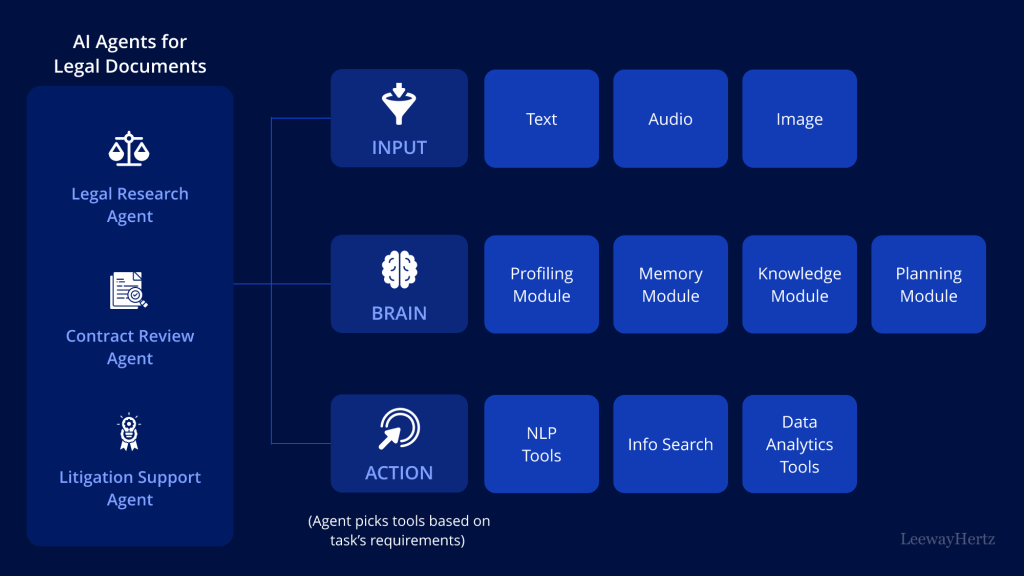
AI agents for legal document management are advanced software solutions designed to streamline and enhance the handling of legal documents. These AI-powered tools use machine learning, natural language processing (NLP), and other sophisticated technologies to automate tasks, improve accuracy, and increase efficiency.
Key Functions of AI Agents in Legal Document Management
AI agents for legal document management perform a variety of functions that simplify the workflow for legal professionals:
- Document Classification and Organization: One of the primary uses of AI agents is to classify and organize documents. By analyzing the content of legal documents, AI agents can categorize them based on type, relevance, and importance. This organization helps lawyers and legal staff quickly locate and retrieve necessary documents, reducing time spent searching through physical or digital files.
- Automated Document Review: AI agents can automate the review process by identifying key clauses, terms, and potential issues within legal documents. This capability is particularly useful for contract review, where AI agents can flag unusual terms or deviations from standard practices, enabling legal professionals to address these issues promptly.
- Enhanced Search Capabilities: Searching through large volumes of legal documents can be cumbersome. AI agents improve search functionalities by understanding context and semantics, allowing users to perform more precise searches. This feature ensures that relevant documents are found quickly, even if they are not keyword-matched exactly.
- Compliance Monitoring: Ensuring compliance with legal standards and regulations is a critical aspect of legal document management. AI agents can continuously monitor documents for compliance with regulatory requirements, alerting users to potential issues before they become problematic.
- Document Drafting and Generation: AI agents can assist in drafting and generating legal documents by leveraging templates and previous data. This capability not only speeds up the document creation process but also ensures consistency and accuracy in legal documents.
Benefits of Using AI Agents for Legal Document Management
The adoption of AI agents for legal document management offers numerous benefits for law firms and legal departments:
- Increased Efficiency: By automating repetitive and time-consuming tasks, AI agents free up valuable time for legal professionals. This increased efficiency allows legal staff to focus on more strategic and high-value activities.
- Improved Accuracy: Human error is an inherent risk in document management. AI agents reduce the likelihood of mistakes by systematically analyzing and processing documents, leading to more accurate results and reducing the risk of costly errors.
- Cost Savings: Automating document management tasks can lead to significant cost savings. With AI agents handling routine tasks, law firms can reduce labor costs and allocate resources more effectively.
- Better Compliance: AI agents help ensure that documents adhere to legal standards and regulatory requirements. By continuously monitoring for compliance, these agents minimize the risk of legal and financial repercussions.
- Enhanced Data Security: AI agents for legal document management often come with advanced security features. These include encryption, access controls, and audit trails, which protect sensitive information and ensure that only authorized personnel can access specific documents.
Challenges and Considerations
While AI agents offer substantial benefits, there are also challenges to consider:
- Integration with Existing Systems: Integrating AI agents with current document management systems can be complex. It requires careful planning and technical expertise to ensure a seamless transition.
- Data Privacy Concerns: Handling sensitive legal information with AI agents necessitates robust data privacy measures. Organizations must ensure that AI solutions comply with data protection regulations and implement appropriate safeguards.
- Training and Adaptation: Legal professionals need to be trained to effectively use AI agents. The adoption of new technology can initially disrupt established workflows, requiring time and effort to adapt.
- Cost of Implementation: Although AI agents can lead to long-term cost savings, the initial investment in AI technology can be substantial. Organizations must weigh the upfront costs against the anticipated benefits.
The Future of AI Agents in Legal Document Management
The future of AI agents for legal document management looks promising. As technology continues to evolve, AI agents will become increasingly sophisticated, offering even more advanced features and capabilities. Innovations in AI are likely to enhance document management processes further, making them more intuitive and effective.
In conclusion, AI agents for legal document management represent a significant advancement in the legal industry. By automating and optimizing various aspects of document handling, these agents provide legal professionals with the tools needed to manage their workloads more efficiently and accurately. While there are challenges to address, the benefits of AI agents are clear, and their continued development will undoubtedly shape the future of legal document management.
 FinTech blogs
Leave a comment