Introduction
In the digital age, managing vast amounts of information efficiently is critical for business success. AI agents for knowledge management are emerging as powerful tools to help organizations streamline data processes, enhance decision-making, and improve overall productivity. This article explores the role of AI agents in knowledge management, their benefits, and how they are transforming the way businesses handle information.
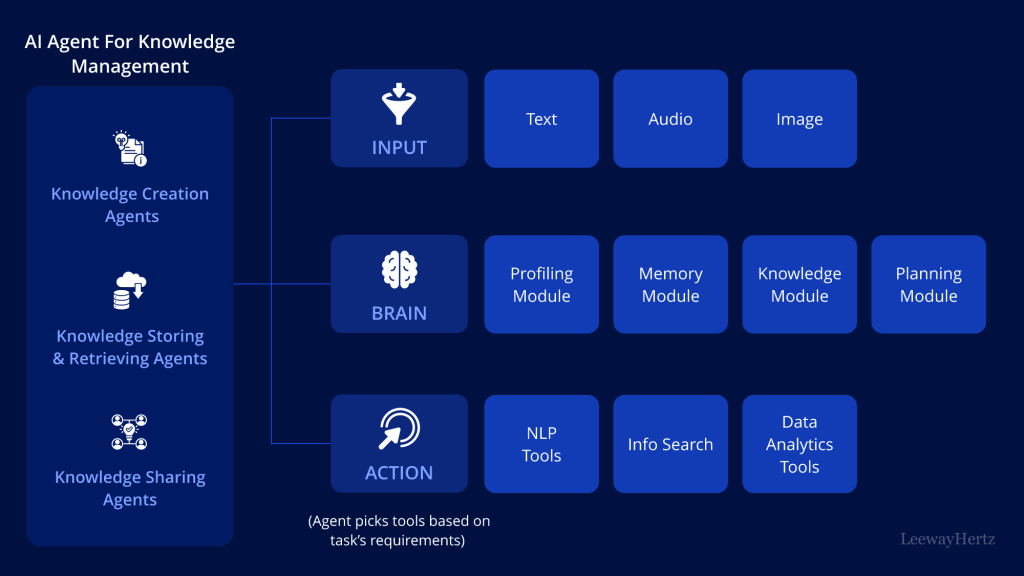
What are AI Agents for Knowledge Management?
AI agents for knowledge management are intelligent systems designed to assist in the collection, organization, and distribution of information within an organization. These agents leverage advanced technologies such as natural language processing (NLP), machine learning, and data analytics to provide insights, automate tasks, and facilitate knowledge sharing.
The primary function of AI agents in knowledge management is to ensure that the right information is available to the right people at the right time. By automating the extraction and organization of data, AI agents can significantly reduce the time employees spend searching for information, allowing them to focus on more strategic tasks.
Benefits of AI Agents for Knowledge Management
- Enhanced Data Organization and Retrieval One of the key benefits of AI agents for knowledge management is their ability to organize and retrieve data efficiently. AI agents can process large volumes of information from various sources, categorize it, and make it easily accessible to users. This not only saves time but also improves the accuracy of information retrieval, ensuring that employees have access to the most relevant data.
- Improved Decision-Making AI agents for knowledge management provide valuable insights by analyzing data patterns and trends. This helps decision-makers to make informed choices based on real-time information. For instance, AI agents can predict market trends, customer behavior, and potential risks, enabling businesses to develop proactive strategies.
- Automation of Repetitive Tasks AI agents excel at automating repetitive tasks such as data entry, report generation, and document classification. By taking over these mundane tasks, AI agents allow employees to concentrate on higher-value activities that require creativity and critical thinking. This automation also minimizes human errors, leading to more reliable data management.
- Facilitating Knowledge Sharing and Collaboration AI agents for knowledge management play a crucial role in fostering collaboration within an organization. By creating a centralized knowledge repository, AI agents ensure that information is easily shared among team members. This promotes a culture of knowledge sharing, which is essential for innovation and continuous improvement.
- Personalized User Experience AI agents can be tailored to meet the specific needs of individual users. By understanding user preferences and behavior, AI agents can deliver personalized content and recommendations. This customization enhances the user experience, making it easier for employees to find the information they need quickly and efficiently.
Applications of AI Agents in Knowledge Management
- Customer Support and Service AI agents for knowledge management are widely used in customer support to provide quick and accurate responses to inquiries. By accessing a comprehensive knowledge base, AI agents can resolve common customer issues without human intervention, leading to faster service and increased customer satisfaction.
- Human Resources Management In HR, AI agents can assist in managing employee records, training materials, and policy documents. They can also help in onboarding new employees by providing access to relevant information and resources. This streamlines HR processes and ensures that employees have the information they need to perform their roles effectively.
- Content Management Systems AI agents can enhance content management systems by automatically categorizing and tagging documents, making it easier for users to find the information they need. They can also monitor content usage and suggest updates or new content based on user interactions, ensuring that the knowledge base remains up-to-date and relevant.
- Research and Development In research and development, AI agents can analyze large datasets, identify patterns, and generate insights that drive innovation. By automating data analysis, AI agents reduce the time and effort required for research, allowing teams to focus on developing new products and solutions.
Challenges and Future of AI Agents for Knowledge Management
While AI agents for knowledge management offer numerous benefits, they also present challenges. Issues such as data privacy, security, and the need for continuous updates to AI algorithms can pose obstacles. Additionally, integrating AI agents into existing systems requires careful planning and a clear strategy.
However, the future of AI agents in knowledge management is promising. As technology continues to evolve, AI agents will become more sophisticated, capable of handling even more complex tasks. Businesses that invest in AI agents for knowledge management today will be well-positioned to leverage these advancements, gaining a competitive edge in the marketplace.
Conclusion
AI agents for knowledge management are transforming the way businesses handle information. By automating data processes, enhancing decision-making, and fostering collaboration, AI agents are helping organizations achieve greater efficiency and productivity. As AI technology continues to advance, the role of AI agents in knowledge management will only grow, making them an essential tool for modern businesses. Embracing AI agents for knowledge management is not just a trend—it’s a strategic move towards a smarter, more agile future.
 FinTech blogs
Leave a comment