Data has become one of the most valuable resources in the modern world. With the explosion of data generation across industries, the need for efficient data analysis tools has never been greater. Enter AI agents for data analysis—a groundbreaking technology that is transforming how businesses and organizations handle vast amounts of data.
Understanding AI Agents for Data Analysis
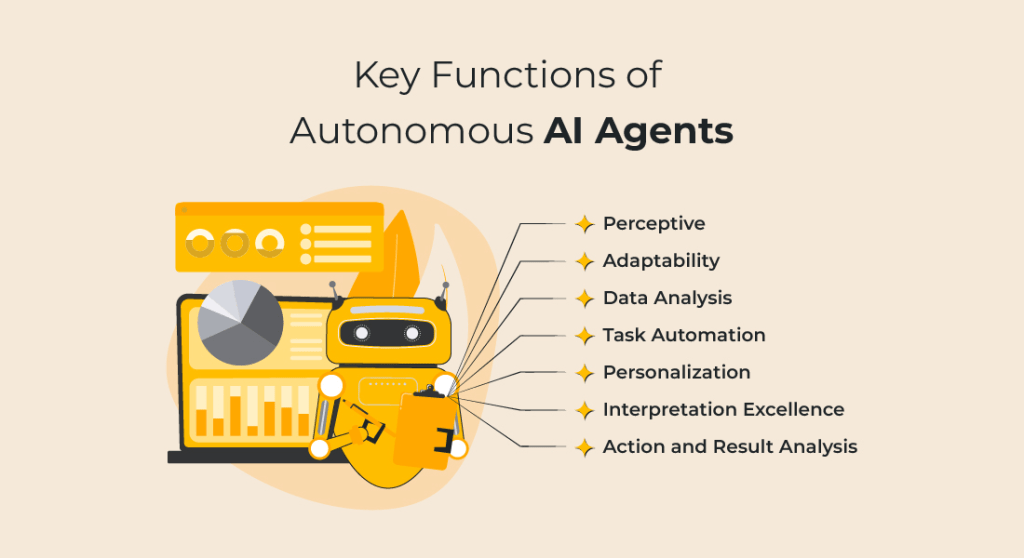
AI agents for data analysis are intelligent software systems designed to autonomously process, analyze, and interpret complex data sets. These agents utilize advanced algorithms and machine learning techniques to identify patterns, trends, and insights that would be difficult, if not impossible, for humans to detect manually. Unlike traditional data analysis methods, AI agents can handle massive volumes of data in real-time, making them indispensable in today’s data-driven environment.
These AI agents are trained on specific tasks, allowing them to specialize in various forms of data analysis, such as predictive analytics, anomaly detection, and natural language processing. Their ability to learn from data and improve over time makes them highly adaptable, continuously enhancing their performance as they process more data.
The Role of AI Agents in Modern Data Analysis
In the modern business landscape, data analysis is crucial for making informed decisions. AI agents for data analysis play a pivotal role in this process by automating the analysis of large and complex data sets. Here are some of the key roles AI agents play in data analysis:
1. Data Collection and Preprocessing
Before any meaningful analysis can take place, data needs to be collected, cleaned, and preprocessed. AI agents excel in this area by automating the tedious and time-consuming tasks of data collection and preprocessing. They can gather data from multiple sources, handle missing values, and normalize data formats, ensuring that the data is ready for analysis. This automation not only saves time but also reduces the risk of human error, resulting in more accurate analysis outcomes.
2. Pattern Recognition and Trend Analysis
One of the most powerful capabilities of AI agents for data analysis is their ability to recognize patterns and trends within large data sets. Whether it’s identifying consumer behavior patterns, market trends, or anomalies in financial transactions, AI agents can quickly process vast amounts of data to uncover hidden insights. These insights can then be used to inform strategic decisions, optimize operations, and gain a competitive edge in the market.
3. Predictive Analytics
Predictive analytics is another area where AI agents for data analysis shine. By analyzing historical data, AI agents can forecast future outcomes with remarkable accuracy. This is particularly valuable in industries such as finance, healthcare, and retail, where predicting future trends can lead to significant cost savings and improved customer experiences. For example, in healthcare, AI agents can analyze patient data to predict disease outbreaks or patient outcomes, enabling proactive measures to be taken.
4. Real-Time Data Analysis
The ability to analyze data in real-time is a game-changer for businesses that rely on quick decision-making. AI agents for data analysis can process and analyze data as it is generated, providing immediate insights that can be acted upon instantly. This is particularly useful in industries such as finance, where real-time data analysis can help detect fraudulent activities, or in manufacturing, where it can optimize production processes on the fly.
5. Natural Language Processing and Text Analysis
AI agents are also equipped with natural language processing (NLP) capabilities, allowing them to analyze unstructured data, such as text from social media, customer reviews, or emails. This enables businesses to gain insights from qualitative data, which is often more challenging to analyze using traditional methods. For instance, AI agents can analyze customer feedback to identify common themes, sentiments, and areas for improvement, helping companies to enhance their products and services.
Benefits of Using AI Agents for Data Analysis
The adoption of AI agents for data analysis offers several benefits that are transforming the way organizations approach data:
1. Efficiency and Speed
AI agents can process large volumes of data at speeds far beyond human capability. This efficiency allows organizations to analyze data in real-time, leading to faster decision-making and more agile operations.
2. Accuracy and Precision
By automating data analysis, AI agents reduce the risk of human error, ensuring that the results are more accurate and reliable. This precision is particularly important in fields where data accuracy is critical, such as healthcare and finance.
3. Scalability
AI agents can easily scale to handle increasing amounts of data, making them ideal for businesses experiencing rapid growth or dealing with big data. As the volume of data grows, AI agents continue to deliver high-quality analysis without compromising on performance.
4. Cost-Effectiveness
Implementing AI agents for data analysis can lead to significant cost savings. By automating routine data analysis tasks, organizations can reduce labor costs and allocate resources more efficiently.
Challenges and Considerations
While AI agents for data analysis offer numerous advantages, there are also challenges to consider:
1. Data Privacy and Security
The use of AI agents involves the handling of large amounts of data, raising concerns about data privacy and security. Organizations must ensure that they comply with data protection regulations and implement robust security measures to safeguard sensitive information.
2. Interpretability of Results
AI agents can sometimes produce results that are difficult to interpret, especially when using complex machine learning models. It is crucial for organizations to ensure that the insights generated by AI agents are understandable and actionable.
3. Integration with Existing Systems
Integrating AI agents into existing data analysis workflows can be challenging, particularly for organizations with legacy systems. Proper planning and a clear strategy are essential for successful integration.
Conclusion
AI agents for data analysis are revolutionizing the way organizations approach data. Their ability to automate and enhance data analysis processes is driving efficiency, accuracy, and cost savings across industries. As AI technology continues to evolve, the role of AI agents in data analysis will only become more critical, helping businesses unlock the full potential of their data and stay ahead in an increasingly competitive landscape.
 FinTech blogs
Leave a comment