Artificial Intelligence (AI) has seen remarkable advancements in recent years, and one of the key developments reshaping this field is Automated Machine Learning (AutoML). AutoML is transforming AI by simplifying the process of building, training, and optimizing machine learning models. It is making AI more accessible to a broader audience, improving the efficiency of AI development, and unlocking the potential for more innovative applications. This article explores how AutoML is transforming AI, breaking down the complexities of the process and showing how this technology is revolutionizing various industries.
What is AutoML?
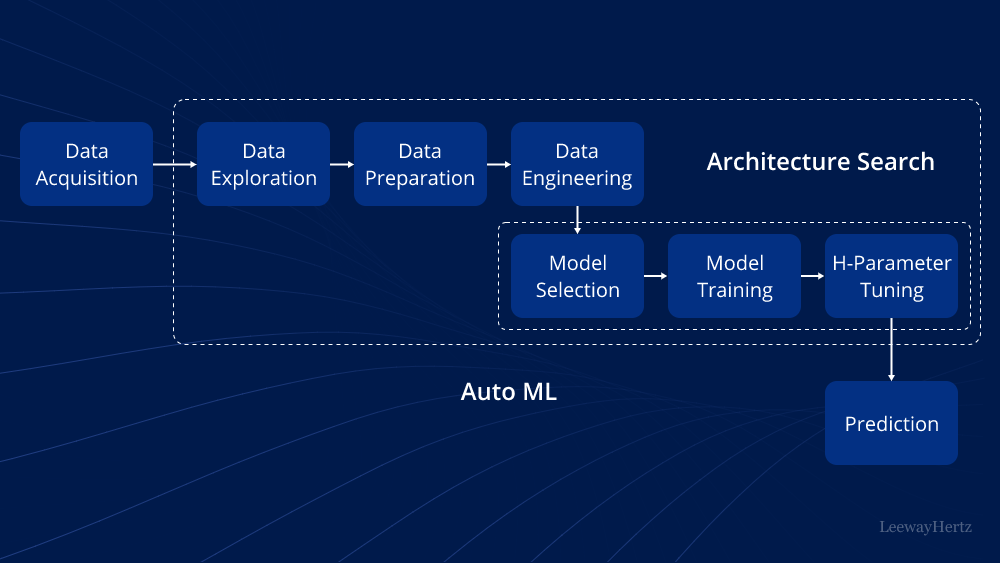
To understand how AutoML is transforming AI, it’s essential to first grasp what AutoML is. In essence, AutoML is the process of automating the steps involved in building machine learning models, from data pre-processing to model selection, training, and hyperparameter tuning. Traditionally, creating an AI model required extensive knowledge in data science, statistics, and machine learning, which meant only experts could build effective models. AutoML democratizes this process by allowing non-experts to design AI solutions with minimal input.
By automating the model creation process, AutoML enables developers to focus on solving business problems rather than spending countless hours tweaking algorithms and parameters. This ability to streamline and simplify the development process is one of the main reasons why AutoML is transforming AI at such a rapid pace.
How AutoML is Revolutionizing AI Development
One of the most profound ways AutoML is transforming AI is through its impact on the development lifecycle. Traditionally, creating a machine learning model involved several stages: data cleaning, feature selection, model selection, and optimization. Each of these stages is time-consuming and requires deep expertise. However, with AutoML, many of these tasks are either fully automated or significantly simplified.
Faster Time-to-Deploy AI Models
The time required to build and deploy AI models has historically been a significant barrier to adoption. AutoML drastically reduces this time by automating critical steps in the machine learning pipeline. For businesses and industries where speed is crucial, such as finance, healthcare, and logistics, AutoML allows for faster development and deployment of AI-driven solutions. This quicker turnaround time means organizations can respond more rapidly to changing conditions or new opportunities, making AI more agile and responsive to real-world needs.
Reducing Human Error
Another crucial way AutoML is transforming AI is by minimizing human error in the development process. Even seasoned data scientists can make mistakes when manually handling data preprocessing, model selection, and parameter tuning. AutoML helps reduce these errors by using sophisticated algorithms to automate many of the tedious and error-prone tasks that humans would otherwise perform. This leads to more accurate models, more reliable results, and ultimately, better AI applications.
Democratization of AI and Machine Learning
AutoML is also playing a pivotal role in making AI accessible to a broader range of people and organizations. By automating many of the complex tasks involved in machine learning, AutoML enables individuals and businesses without a deep background in AI to harness its power. This democratization of AI is one of the most impactful ways AutoML is transforming AI.
Empowering Non-Experts
With AutoML, you don’t need to be a machine learning expert to build a model. It opens the door for individuals in various fields—such as marketing, product management, and operations—to create and deploy AI solutions tailored to their specific needs. This is particularly important for small and medium-sized enterprises (SMEs), which often lack the resources to hire specialized data scientists but still want to leverage AI to improve their operations.
By lowering the barriers to entry, AutoML is expanding the reach of AI to a much wider audience, fostering innovation across sectors that might not have been able to explore AI solutions before.
Improving AI Accessibility Across Industries
In addition to empowering individual users, AutoML is transforming AI by making it more accessible across various industries. From agriculture to education, organizations are finding new ways to implement AI solutions thanks to the ease and flexibility of AutoML platforms. This widespread adoption of AI is leading to breakthroughs that were previously unattainable due to the technical complexities involved in developing AI models from scratch.
How AutoML is Driving Innovation
The rapid adoption of AutoML is not just making AI development faster and more accessible—it’s also fostering innovation across multiple sectors. As AutoML continues to evolve, it’s allowing researchers and developers to experiment with more advanced and sophisticated models that push the boundaries of what AI can achieve.
Enabling More Complex AI Models
One significant way AutoML is transforming AI is by enabling the development of more complex and specialized models. Traditionally, building such models would have required months of work and a team of experts. AutoML streamlines this process, allowing for the development of highly accurate and complex models in a fraction of the time. This has opened up possibilities for innovations in areas such as natural language processing, image recognition, and predictive analytics.
Facilitating Rapid Experimentation
Because AutoML automates so many of the time-consuming aspects of machine learning, it allows developers to experiment with multiple models and configurations quickly. This rapid experimentation accelerates the innovation process, enabling teams to test different hypotheses and iterate on their models more efficiently. The ability to rapidly iterate and refine models is a key reason why AutoML is transforming AI, driving breakthroughs that would have been much slower to achieve using traditional methods.
The Future of AI with AutoML
The impact of AutoML on AI development is already significant, but its potential for future growth is even more exciting. As AutoML continues to improve, it will likely lead to the development of even more advanced tools that will push the boundaries of what AI can do. It’s anticipated that AutoML will play a critical role in shaping the future of AI, particularly as it becomes increasingly integrated with other emerging technologies like quantum computing and advanced robotics.
Continuous Advancements in AI Capabilities
As AutoML tools become more sophisticated, the types of AI applications they can support will continue to expand. From self-driving cars to personalized medicine, AutoML is poised to help bring more advanced AI solutions to the forefront of innovation.
Bridging the Skills Gap in AI
In addition, AutoML will play a crucial role in addressing the skills gap in AI and machine learning. By making it easier for non-experts to engage with AI technologies, AutoML will help bridge the gap between demand and the limited supply of AI experts, further accelerating the adoption of AI across industries.
Conclusion
AutoML is transforming AI in profound ways by making it faster, more efficient, and accessible to a broader audience. Through automation, it reduces the complexity of building machine learning models, accelerates time-to-market for AI solutions, and opens up opportunities for innovation across various sectors. As the capabilities of AutoML continue to evolve, its transformative impact on AI will only grow, shaping the future of artificial intelligence in ways we are only beginning to imagine.
 FinTech blogs
Leave a comment