Generative AI is revolutionizing industries by enabling machines to create content that resembles human work. Whether it’s generating text, images, or music, understanding how to build a generative AI solution can empower innovators and businesses alike. This guide provides a clear, straightforward approach to creating a generative AI system.
Understanding Generative AI
Generative AI refers to algorithms that can create new content based on learned patterns from existing data. These systems use techniques like deep learning to generate outputs that mimic the characteristics of the input data. Examples include text generators, image synthesis tools, and even music composition algorithms.
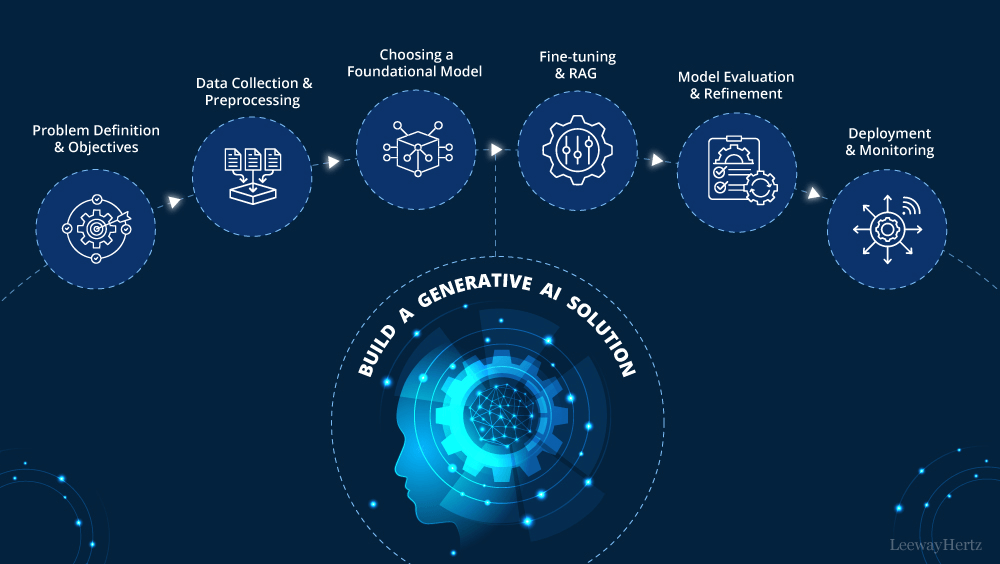
Step 1: Define Your Objectives
The first step in building a generative AI solution is to clearly define your objectives. Ask yourself:
- What type of content do you want to generate?
- Who is your target audience?
- What are the specific use cases for your solution?
A well-defined goal will guide your choice of data, algorithms, and evaluation metrics.
Step 2: Gather and Prepare Data
Data is the foundation of any AI solution. The quality and quantity of data you collect will significantly impact the performance of your generative AI model. Here’s how to gather and prepare your data:
- Identify Sources: Look for datasets that are relevant to your objectives. Publicly available datasets, web scraping, or proprietary data can all be valuable.
- Clean the Data: Remove duplicates, correct errors, and ensure consistency. This step is crucial for training an effective model.
- Format the Data: Organize your data in a way that is compatible with your chosen AI framework. Consider splitting it into training, validation, and testing sets.
Step 3: Choose the Right Model
Selecting the appropriate model is crucial for your generative AI solution. There are several architectures to consider:
- Generative Adversarial Networks (GANs): These consist of two neural networks that work against each other to create realistic outputs.
- Variational Autoencoders (VAEs): These models encode input data into a latent space and then decode it back to generate new data.
- Transformers: Popular in text generation, transformers like GPT use attention mechanisms to understand context and generate coherent outputs.
Your choice will depend on the type of content you wish to generate and the complexity of your data.
Step 4: Train Your Model
Training is where the real magic happens. It involves feeding your prepared data into the model and adjusting the parameters to minimize error. Here are key considerations for this step:
- Set Up Your Environment: Use a robust framework that supports your chosen model. Consider cloud-based solutions for scalability.
- Choose Hyperparameters: These settings can significantly influence your model’s performance. Experiment with learning rates, batch sizes, and epochs to find the optimal configuration.
- Monitor Performance: Track metrics like loss and accuracy during training to ensure your model is learning effectively.
Step 5: Evaluate and Fine-Tune
Once your model is trained, it’s time to evaluate its performance. Use the validation set to assess how well your model generates content. Common evaluation methods include:
- Qualitative Analysis: Review the generated outputs to determine if they meet your quality standards.
- Quantitative Metrics: Use metrics like BLEU scores for text or Inception scores for images to quantitatively assess performance.
Based on this evaluation, you may need to fine-tune your model by adjusting hyperparameters, adding more data, or even selecting a different architecture.
Step 6: Deploy Your Solution
After fine-tuning, you’re ready to deploy your generative AI solution. This involves integrating the model into a user-friendly interface or application. Here are steps to consider:
- Choose a Deployment Strategy: Options include cloud services, on-premise deployment, or edge computing, depending on your needs.
- Implement API Access: Providing an API allows other applications to interact with your generative model seamlessly.
- Monitor Performance Post-Deployment: Continuously evaluate your model’s performance and gather user feedback to identify areas for improvement.
Step 7: Iterate and Improve
Building a generative AI solution is not a one-time task; it’s an ongoing process. After deployment, regularly update your model based on new data and feedback. Consider the following:
- Regular Updates: Incorporate new data to keep your model relevant.
- User Feedback: Engage with users to understand their needs and improve your solution accordingly.
- Experimentation: Stay open to experimenting with new models and techniques to enhance your generative AI solution.
Conclusion
Building a generative AI solution requires a thoughtful approach that encompasses defining objectives, gathering data, choosing the right model, and continuous improvement. By following this step-by-step guide, you can create a generative AI system that meets your needs and stands out in a competitive landscape. As technology evolves, staying informed and adaptable will be key to the success of your generative AI projects.
 FinTech blogs
Leave a comment