In recent years, the rapid evolution of artificial intelligence has started to make waves across various industries, and corporate accounting is no exception. Among the most exciting advancements is the rise of generative AI for corporate accounting, which has the potential to revolutionize how businesses manage their financial operations. This article delves into how generative AI is reshaping corporate accounting, streamlining processes, and enhancing decision-making.
What is Generative AI?
Generative AI refers to a subset of artificial intelligence that uses machine learning models to create new content, such as text, images, and even predictions. Unlike traditional AI, which primarily follows predefined rules, generative AI learns patterns from existing data and generates outcomes that can be used for various applications. In the realm of corporate accounting, generative AI can generate financial reports, provide forecasts, and automate complex accounting tasks, making it a game-changer for finance teams.
How Generative AI is Transforming Corporate Accounting
1. Automating Repetitive Accounting Tasks
One of the most significant ways generative AI for corporate accounting is changing the landscape is through automation. Many accounting tasks are repetitive, such as data entry, reconciliations, and invoice processing. Generative AI can streamline these tasks by analyzing historical data and automatically performing these operations without human intervention. This not only reduces the chances of errors but also frees up accountants to focus on more strategic tasks.
For instance, month-end closing, a traditionally labor-intensive process, can be expedited using AI-powered automation. Generative AI models can review financial statements, identify discrepancies, and propose adjustments in real-time. As a result, organizations experience faster, more accurate closings, improving overall efficiency.
2. Enhancing Financial Forecasting
Accurate financial forecasting is crucial for business planning and decision-making. Generative AI for corporate accounting enables more precise forecasting by analyzing large sets of historical and real-time data. This allows companies to generate better financial models, predict market trends, and prepare for future uncertainties.
Unlike traditional forecasting methods, generative AI continuously learns and adapts based on new inputs. This dynamic capability enhances the accuracy of predictions and helps businesses make data-driven decisions with greater confidence. By understanding past patterns and simulating various economic scenarios, generative AI offers insights that can shape corporate strategies in meaningful ways.
3. Improving Compliance and Risk Management
Compliance with regulatory requirements is a major challenge for businesses, especially those operating in multiple jurisdictions. With generative AI for corporate accounting, compliance processes can be streamlined by automating the monitoring of regulatory changes and generating reports that meet legal standards. AI can also automatically flag potential compliance risks or errors in financial statements, reducing the risk of costly penalties.
Additionally, generative AI is being used to assess financial risks by analyzing vast amounts of internal and external data. This technology can identify irregular patterns, predict potential financial fraud, and assess the likelihood of risky transactions, all of which enhance corporate risk management efforts. Accountants can leverage these insights to take proactive measures, ensuring that companies remain in good standing with financial regulators.
4. Facilitating Better Decision-Making
The implementation of generative AI for corporate accounting empowers decision-makers with deeper insights into their financial operations. AI systems can analyze complex data sets and generate reports that provide meaningful insights into areas like cash flow, profitability, and budget variances. This enables executives to make well-informed decisions that directly impact business growth and financial stability.
Moreover, generative AI can help finance teams visualize data in real-time, allowing them to track key performance indicators (KPIs) and compare them against industry benchmarks. By having access to these AI-generated insights, corporate leaders can make faster and more strategic decisions, positioning their organizations for success in an increasingly competitive market.
5. Enhancing Efficiency Through Personalized Solutions
Another compelling feature of generative AI for corporate accounting is its ability to offer personalized solutions tailored to specific business needs. Every company has unique accounting requirements, and generative AI can adapt to provide customized workflows, reporting structures, and financial models that best suit a company’s operations.
For example, AI can generate tailored financial reports based on the specific needs of different departments or stakeholders. By providing these personalized solutions, generative AI reduces the need for manual adjustments, enhances accuracy, and saves time. It also enables businesses to focus more on their growth strategies rather than getting bogged down by administrative tasks.
The Challenges of Implementing Generative AI in Corporate Accounting
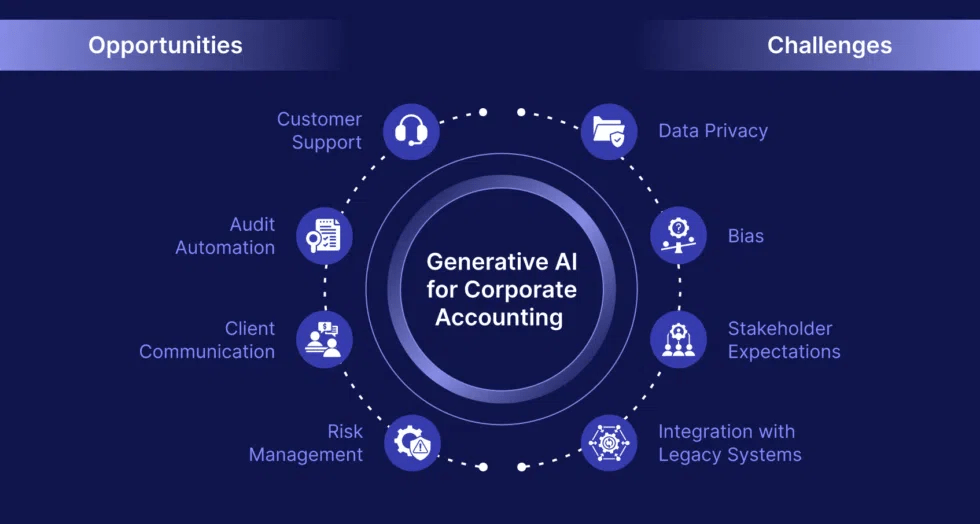
While the benefits of generative AI for corporate accounting are vast, it’s important to acknowledge the challenges that come with its implementation. One of the biggest hurdles is the need for quality data. For AI to produce accurate outcomes, it must be fed clean and relevant data. Many organizations face challenges in gathering and organizing this data efficiently.
Additionally, there is the issue of trust. Accountants and finance professionals may be hesitant to rely solely on AI-generated reports without manual verification. This concern can be mitigated by using generative AI as an assistive tool rather than a complete replacement, combining the strengths of AI with human expertise.
There are also ethical concerns related to data privacy, especially when dealing with sensitive financial information. Businesses must ensure that the use of generative AI complies with data protection laws and that the AI models used are transparent and secure.
The Future of Generative AI in Corporate Accounting
As AI technology continues to advance, the role of generative AI for corporate accounting will only grow. The future promises more sophisticated AI models capable of handling even more complex financial tasks. We can expect to see AI integrated into broader financial ecosystems, working alongside other enterprise technologies to create a more seamless and efficient corporate accounting process.
In the coming years, it’s likely that generative AI will evolve from being a tool that assists with routine tasks to becoming a strategic partner for finance teams. By enhancing predictive capabilities, improving accuracy, and streamlining compliance, generative AI is set to become a cornerstone of the corporate accounting function.
Conclusion
Generative AI has emerged as a powerful tool in corporate accounting, helping organizations automate tasks, forecast financial outcomes, improve compliance, and make better decisions. While the technology is still evolving, its potential to transform the accounting landscape is undeniable. By embracing generative AI for corporate accounting, businesses can stay ahead of the curve, driving innovation and efficiency in their financial operations.
With continued advancements in AI, the future of corporate accounting looks brighter than ever. Companies that leverage this technology effectively will be well-positioned to thrive in an increasingly data-driven world.
 FinTech blogs
Leave a comment