Internal audit teams play a critical role in ensuring that organizations maintain compliance, manage risk, and operate efficiently. Traditionally, internal audits have relied on manual processes and rule-based systems to evaluate controls, transactions, and operational processes. However, the rapid development of advanced technologies, particularly generative AI, is transforming the internal audit landscape. Generative AI for internal audit brings a new level of automation, insight, and efficiency to the process, allowing auditors to focus on high-value tasks and enhance audit quality.
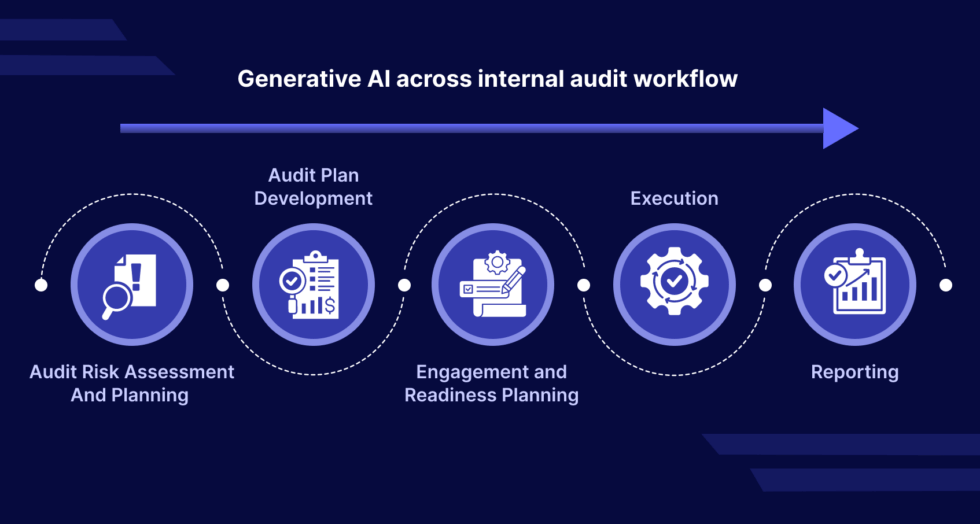
What is Generative AI and How Does it Apply to Internal Audit?
Generative AI refers to artificial intelligence systems that create new data or content by learning patterns from existing datasets. These AI models can generate text, images, or even predictions based on the information they have been trained on. In the context of internal audit, generative AI has the potential to analyze vast amounts of financial and operational data, detect anomalies, and provide insights for risk management and compliance.
Generative AI for internal audit works by leveraging machine learning algorithms to automatically evaluate datasets for patterns, trends, and irregularities. It can identify potential areas of concern, such as fraud, non-compliance, or inefficiencies, without human intervention. This makes generative AI a valuable tool for auditors, as it provides more thorough analysis and reduces the risk of human error.
Benefits of Using Generative AI for Internal Audit
1. Enhanced Efficiency and Accuracy
One of the primary advantages of generative AI for internal audit is its ability to automate time-consuming tasks. Traditionally, auditors spend considerable time gathering, sorting, and analyzing data manually. Generative AI can quickly process large volumes of data, reducing the time required for these tasks and allowing auditors to focus on more strategic activities, such as assessing risks and improving processes.
Generative AI also enhances the accuracy of audits. Human auditors may overlook errors or anomalies, especially when dealing with massive datasets. AI-driven tools can analyze data with greater precision, flagging potential risks that might otherwise go unnoticed.
2. Improved Risk Detection
Generative AI for internal audit excels at identifying patterns and anomalies that indicate potential risks. The technology can sift through vast amounts of financial transactions, operational data, and compliance records, spotting inconsistencies that might suggest fraud or operational inefficiencies.
By using generative AI to monitor transactions and processes in real-time, internal auditors can detect issues early and mitigate risks before they escalate. This proactive approach is particularly useful in industries with high levels of regulatory scrutiny, where the ability to detect and correct issues quickly is paramount.
3. Scalability and Flexibility
Internal audits often vary in scope and complexity, depending on the organization’s size, structure, and risk profile. Generative AI for internal audit offers scalability, making it easier to conduct audits of different magnitudes. Whether the audit involves a few departments or spans multiple business units across geographies, generative AI can adapt to the required scale and provide consistent results.
Moreover, generative AI is flexible enough to handle different types of audits, from financial to operational and compliance audits. As organizations evolve, so too can the AI’s capacity to assess and analyze new areas, ensuring the internal audit function remains relevant and effective.
Overcoming Challenges of Implementing Generative AI for Internal Audit
While generative AI for internal audit offers significant benefits, implementing it effectively requires overcoming several challenges.
1. Data Quality and Availability
For generative AI to function optimally, it needs access to high-quality, structured data. In many organizations, data is scattered across multiple systems, making it difficult to collect and standardize. Internal audit teams must collaborate with IT departments to ensure that data is properly integrated and cleaned before it is analyzed by AI tools.
Additionally, certain types of unstructured data—such as emails, documents, or logs—may need to be converted into a format that AI models can process. Addressing these data challenges is critical for the successful implementation of generative AI for internal audit.
2. Ethics and Governance Concerns
As with any AI-driven process, there are ethical considerations to address. Generative AI for internal audit must be transparent, unbiased, and accountable. The use of AI models should be governed by strict ethical guidelines to prevent discrimination, bias, or unfair treatment of individuals within the organization.
Audit teams must also ensure that AI-driven insights are used responsibly. Generative AI can flag potential risks, but human oversight is still necessary to validate the results and make informed decisions. Implementing proper governance structures helps balance the efficiency of AI with the need for responsible auditing practices.
3. Skills and Training
Another key challenge in adopting generative AI for internal audit is ensuring that audit teams possess the necessary skills to work with AI tools. Generative AI requires understanding of machine learning algorithms, data science, and AI-driven systems. Auditors may need additional training to leverage these technologies effectively.
Investing in skill development is essential for the success of generative AI in internal audit. Organizations must provide ongoing education and resources to ensure that their audit teams remain proficient in both traditional auditing practices and the latest AI-driven technologies.
The Future of Generative AI in Internal Audit
Generative AI for internal audit is still in its early stages, but its potential is undeniable. As the technology continues to evolve, internal auditors will have more powerful tools at their disposal to enhance efficiency, improve risk detection, and provide valuable insights for decision-making.
In the future, generative AI could further revolutionize internal audit by enabling real-time auditing, where audits are conducted continuously rather than periodically. This shift would allow organizations to stay ahead of risks and adapt more quickly to changes in the regulatory landscape.
Moreover, as AI models become more sophisticated, they will likely be able to perform deeper analyses, providing auditors with predictive insights that help them anticipate future risks and challenges.
Conclusion
Generative AI for internal audit is a game-changer, offering numerous benefits including enhanced efficiency, improved accuracy, and better risk detection. By automating time-consuming tasks and providing real-time insights, generative AI allows internal auditors to focus on high-level strategic objectives while ensuring that organizations stay compliant and manage risks effectively.
 FinTech blogs
Leave a comment