Introduction
In the rapidly evolving landscape of business and finance, due diligence plays a critical role in ensuring that companies make well-informed decisions. This process, traditionally resource-intensive, now benefits from advanced technologies like generative AI. Leveraging the capabilities of generative AI in due diligence can dramatically improve speed, accuracy, and depth, transforming how organizations approach risk assessment and investment analysis.
What is Generative AI in Due Diligence?
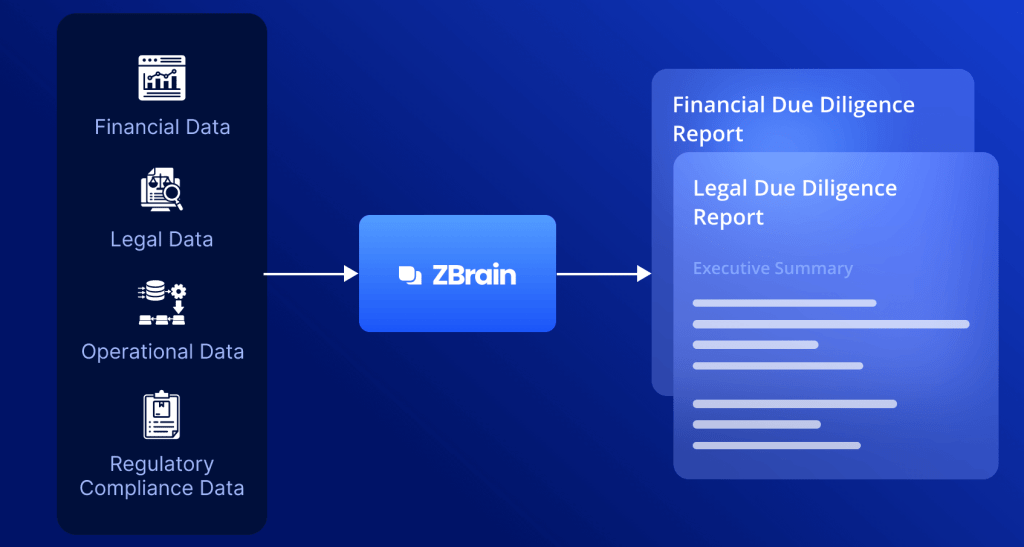
Generative AI is a subset of artificial intelligence focused on creating content, data, or insights based on pre-existing data. In due diligence, it can assist in gathering information, identifying risks, and producing recommendations. The integration of generative AI in due diligence helps companies automate repetitive tasks, analyze complex datasets, and generate reports that outline potential risks and opportunities.
How Generative AI Enhances the Due Diligence Process
The integration of generative AI in due diligence offers several distinct advantages that align well with the needs of modern businesses. Here’s a closer look at how generative AI helps streamline the due diligence process:
1. Automated Data Collection and Analysis
Due diligence often requires extensive data collection, which can be time-consuming and error-prone if done manually. Generative AI tools can automatically gather data from various sources, such as financial statements, market reports, and regulatory filings. By implementing generative AI in due diligence, companies can quickly access reliable data, allowing decision-makers to focus on the analysis instead of the collection process.
2. Improved Risk Detection and Compliance Monitoring
Compliance issues are a primary concern during due diligence, as organizations aim to avoid regulatory pitfalls. Generative AI systems can examine vast datasets to detect inconsistencies, regulatory non-compliance, and other potential red flags. By using generative AI in due diligence, companies can identify risks more effectively, ensuring compliance with industry standards and regulations.
3. Natural Language Processing for Document Review
One of the most challenging aspects of due diligence is reviewing large volumes of text-heavy documents. Generative AI models equipped with natural language processing (NLP) capabilities can efficiently analyze legal documents, contracts, and emails to identify key terms, clauses, and patterns. By deploying generative AI in due diligence, companies reduce human error, achieve greater consistency in document reviews, and speed up the analysis.
4. Enhanced Decision Support and Insights Generation
Beyond just collecting and analyzing data, generative AI in due diligence can generate valuable insights that aid in decision-making. AI algorithms can offer predictive analytics, helping companies assess future performance, potential risks, and return on investment. By transforming raw data into actionable insights, generative AI in due diligence provides decision-makers with a clearer understanding of potential investments and partnerships.
5. Time and Cost Efficiency
Traditional due diligence can be both time-consuming and costly. Generative AI-driven systems can automate various aspects of the due diligence process, allowing organizations to conduct thorough assessments in a fraction of the time and at a reduced cost. Integrating generative AI in due diligence not only improves accuracy but also saves valuable resources, making it an ideal solution for small and large businesses alike.
Applications of Generative AI in Different Types of Due Diligence
Different types of due diligence, such as financial, operational, legal, and customer due diligence, can benefit from generative AI in distinct ways. Each area involves different data sources and objectives, which generative AI can address with customized models and techniques.
Financial Due Diligence
Financial due diligence focuses on evaluating a company’s financial health, profitability, and revenue streams. Generative AI can help analyze financial records, identify patterns, and detect discrepancies that may indicate risk. By using generative AI in due diligence for financial assessments, companies ensure they are making sound financial decisions based on data-driven insights.
Legal Due Diligence
Legal due diligence requires a thorough examination of legal documents, intellectual property, and compliance history. Generative AI models with NLP capabilities can analyze large volumes of legal text, identify potential legal risks, and flag non-compliant clauses. Incorporating generative AI in due diligence for legal reviews enables companies to conduct comprehensive assessments faster and with fewer errors.
Operational Due Diligence
Operational due diligence evaluates a company’s business model, management, and operational efficiency. Generative AI can assess industry benchmarks, employee turnover rates, and operational metrics to provide insights into a company’s operational health. With generative AI in due diligence, organizations gain a clearer picture of an acquisition target’s or partner’s operational stability and long-term viability.
Customer and Vendor Due Diligence
Generative AI can also streamline customer and vendor due diligence by analyzing customer feedback, supplier reliability, and market trends. With generative AI in due diligence, companies can assess potential business partners based on customer satisfaction scores, supply chain stability, and other factors that may affect future performance.
Challenges and Ethical Considerations of Generative AI in Due Diligence
While generative AI presents significant advantages, it also comes with potential challenges. Ethical considerations, such as data privacy, accuracy, and bias, are crucial when implementing generative AI in due diligence.
- Data Privacy and Security: Due diligence often involves sensitive data, and AI models must be secure to protect this information. Ensuring that generative AI complies with data privacy laws is vital to maintaining ethical standards.
- Model Accuracy and Interpretability: Generative AI models must produce reliable and interpretable results. Decision-makers must understand how these models arrive at certain conclusions to trust and validate their recommendations.
- Bias Mitigation: AI models can inadvertently carry biases present in the data they are trained on. It’s essential to regularly audit and adjust AI systems to ensure they remain impartial and fair.
The Future of Generative AI in Due Diligence
As generative AI technology advances, its role in due diligence will likely expand. Future innovations may include more accurate predictive analytics, enhanced risk modeling, and more intuitive user interfaces. Integrating generative AI in due diligence will continue to enhance efficiency, allowing companies to focus more on strategic planning and growth.
For organizations looking to stay competitive, embracing generative AI in due diligence will be a key factor. As AI models become more sophisticated and accessible, they will not only optimize due diligence processes but also redefine how companies approach risk assessment and decision-making.
Conclusion
Generative AI in due diligence is proving to be a transformative force, enhancing efficiency, accuracy, and decision-making in complex, data-intensive evaluations. From risk assessment to compliance, generative AI is streamlining every facet of the due diligence process, offering companies a comprehensive and forward-thinking approach to evaluating potential investments and partnerships.
 FinTech blogs
Leave a comment