Introduction
The integration of artificial intelligence (AI) into the financial world has brought significant changes, particularly in the areas of private equity and principal investment. As technology advances, the role of AI in private equity and principal investment has grown exponentially, offering new opportunities for investors and firms alike. This article explores the transformative impact of AI in these sectors, highlighting its benefits, challenges, and future prospects.
Understanding Private Equity and Principal Investment
Private equity refers to investments made in private companies, typically through buyouts or venture capital funding. These investments are usually illiquid, meaning they cannot be easily sold or exchanged. On the other hand, principal investment involves firms investing their own capital, rather than clients’ money, into various assets, including private equity. Both forms of investment are characterized by high-risk, high-reward scenarios, making them crucial areas for technological innovation.
The Role of AI in Private Equity
Enhanced Due Diligence
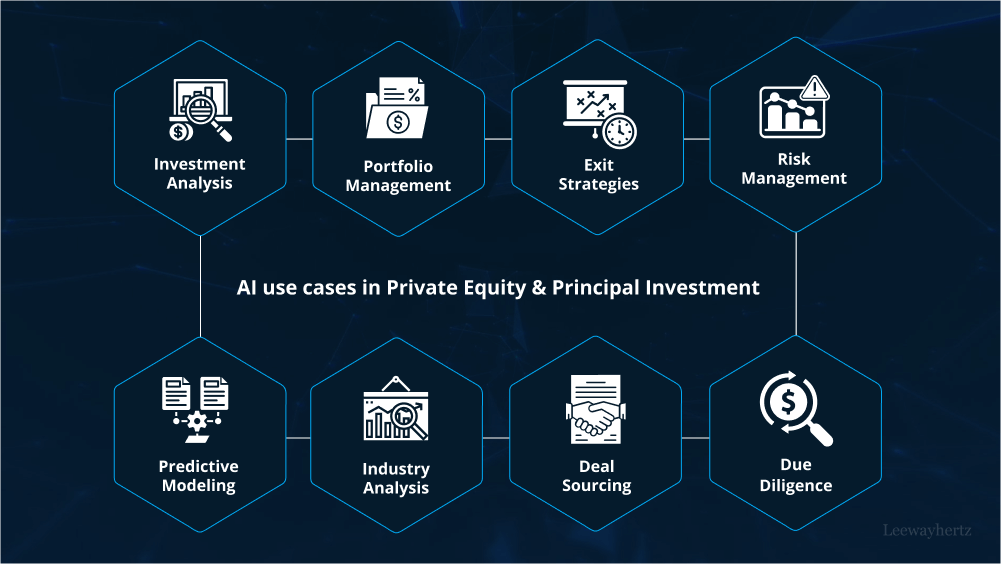
One of the most significant impacts of AI in private equity is the enhancement of due diligence processes. Traditionally, due diligence requires extensive research, analysis, and data collection, which can be time-consuming and prone to human error. AI algorithms can automate much of this process, rapidly analyzing vast amounts of data to identify risks and opportunities. This not only speeds up decision-making but also improves accuracy, allowing private equity firms to make more informed investment decisions.
Predictive Analytics
AI in private equity also leverages predictive analytics to forecast future performance. By analyzing historical data, market trends, and various economic indicators, AI can predict how a potential investment might perform in different scenarios. This ability to forecast with greater precision is invaluable for private equity firms, as it helps in identifying high-potential investments while avoiding those that are likely to underperform.
Portfolio Management
AI plays a crucial role in optimizing portfolio management within private equity. Machine learning algorithms can continuously monitor portfolio companies, providing real-time insights into their performance. This enables private equity firms to make timely adjustments, such as reallocating resources or restructuring operations, to maximize returns. Additionally, AI can identify patterns and correlations that may not be immediately apparent to human analysts, further enhancing portfolio management strategies.
The Impact of AI in Principal Investment
Improved Investment Strategies
In the realm of principal investment, AI is revolutionizing the way firms develop and implement investment strategies. By analyzing large datasets, AI can uncover hidden opportunities and risks that traditional methods might miss. For example, AI can assess the impact of macroeconomic factors on specific assets, helping firms make more strategic decisions. This capability is particularly beneficial for principal investment firms that need to deploy capital efficiently and effectively.
Risk Management
Risk management is a critical aspect of principal investment, and AI is making significant strides in this area. AI-driven models can assess the risk profiles of different investments with greater accuracy, taking into account a wide range of variables that may affect performance. By providing a more nuanced understanding of risk, AI enables principal investment firms to make more informed decisions, reducing the likelihood of significant losses.
Automation of Routine Tasks
AI also brings the benefit of automating routine tasks in principal investment, such as data entry, compliance checks, and reporting. This not only increases efficiency but also allows investment professionals to focus on higher-value activities, such as strategy development and client engagement. The automation of these tasks reduces operational costs and minimizes the risk of human error, further enhancing the effectiveness of principal investment strategies.
Challenges and Considerations
Data Quality and Integration
While the benefits of AI in private equity and principal investment are clear, there are also challenges to consider. One of the primary challenges is ensuring the quality and integration of data. AI relies heavily on accurate, high-quality data to function effectively. Inconsistent or incomplete data can lead to incorrect analyses and poor decision-making. Therefore, firms must invest in robust data management practices to maximize the benefits of AI.
Ethical Considerations
Ethical considerations also play a significant role in the adoption of AI in private equity and principal investment. The use of AI in these sectors raises questions about transparency, accountability, and fairness. For instance, reliance on AI-driven models could lead to biased investment decisions if the underlying algorithms are not properly calibrated. Firms must ensure that their AI systems are transparent and that decisions can be justified to stakeholders.
Regulatory Compliance
Regulatory compliance is another important factor to consider. As AI becomes more prevalent in private equity and principal investment, regulators are increasingly focusing on how these technologies are used. Firms must stay abreast of evolving regulations to ensure that their AI practices are compliant. This may involve working closely with regulators and legal experts to navigate the complex landscape of AI-related regulations.
The Future of AI in Private Equity and Principal Investment
The future of AI in private equity and principal investment looks promising, with continued advancements expected to further transform these sectors. As AI technology evolves, it will likely become even more integrated into the investment process, driving efficiency, improving decision-making, and enhancing overall performance. However, firms must remain vigilant about the challenges and ethical considerations associated with AI to fully harness its potential.
In conclusion, AI is playing an increasingly vital role in private equity and principal investment. From enhancing due diligence and predictive analytics to improving risk management and automating routine tasks, AI is reshaping the way investment firms operate. While challenges remain, the potential benefits of AI in these sectors are immense, making it a crucial tool for the future of private equity and principal investment.


Leave a comment