Building a generative AI solution can seem like a daunting task, but with the right approach, it becomes manageable and rewarding. Generative AI, which includes models that create new data like text, images, music, or even code, has applications in numerous fields. Whether you’re looking to automate content creation, generate realistic images, or develop creative AI, this guide will walk you through the essential steps. This article covers everything you need to know about how to build a generative AI solution, providing a clear, straightforward approach.
1. Understand the Basics of Generative AI
Before diving into how to build a generative AI solution, it’s crucial to understand what generative AI is and how it works. Generative AI models are designed to create new data that resembles existing data. They learn patterns and structures from input data and use that knowledge to generate new content. Common types of generative models include Generative Adversarial Networks (GANs), Variational Autoencoders (VAEs), and Transformer models like GPT-3.
2. Define the Problem and Objectives
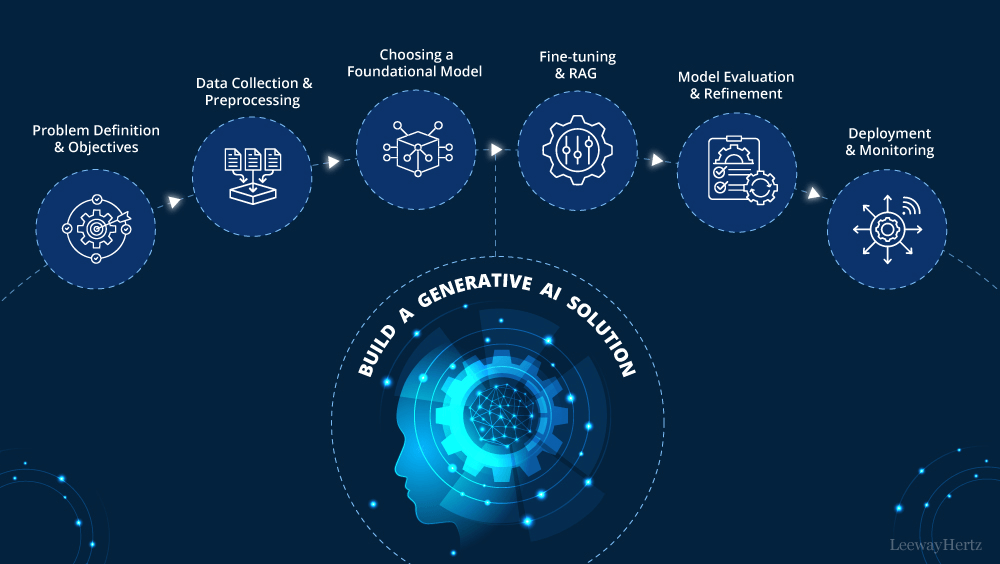
The first step in building a generative AI solution is to clearly define the problem you want to solve. Are you looking to generate text, images, music, or something else? Understanding your goals will help you select the right model and approach. For instance, if your goal is to create realistic images, GANs might be the best choice. If you’re generating text, a Transformer-based model might be more appropriate.
3. Gather and Prepare Your Data
Data is the foundation of any AI solution. For a generative AI model, you need a large and high-quality dataset that represents what you want to generate. If you’re building a text generation model, you’ll need a substantial corpus of text. For image generation, you’ll need a dataset of relevant images.
- Data Collection: Identify sources of data that suit your needs. This could be publicly available datasets, data you collect yourself, or data generated from other AI models.
- Data Cleaning and Preprocessing: Ensure your data is clean and well-prepared. This might include removing duplicates, correcting errors, and normalizing the data format. For text, this might mean tokenizing or vectorizing; for images, resizing and normalizing pixel values.
4. Choose the Right Model and Framework
Selecting the appropriate model architecture is a crucial part of how to build a generative AI solution. Here are some popular choices:
- GANs (Generative Adversarial Networks): Best for generating images, videos, and other visual data.
- VAEs (Variational Autoencoders): Useful for generating data with complex, high-dimensional distributions.
- Transformers: Ideal for text and sequence-based data, such as language models or code generation.
Choose a framework that supports your model type, such as TensorFlow, PyTorch, or Keras. These frameworks provide tools and libraries that make it easier to build, train, and deploy your generative AI model.
5. Train the Model
Training the model is a critical phase in building a generative AI solution. During training, the model learns from the data and improves its ability to generate new, similar data.
- Set Hyperparameters: Configure the model with appropriate hyperparameters, such as learning rate, batch size, and number of epochs. These settings can significantly affect the model’s performance.
- Training Process: Train your model using your prepared data. This involves feeding the data into the model and allowing it to learn through a process of trial and error, adjusting its parameters to minimize errors in the generated outputs.
- Evaluate Performance: Regularly evaluate your model’s performance using metrics relevant to your problem. For image generation, this might include visual inspections or quantitative measures like the Inception Score. For text, it could involve measuring coherence and relevance.
6. Fine-Tune and Optimize
After the initial training, you may need to fine-tune and optimize your model to improve its performance. This step involves tweaking the model’s architecture, adjusting hyperparameters, or using techniques like transfer learning to boost accuracy and efficiency.
- Regularization: Apply techniques like dropout or weight decay to prevent overfitting.
- Optimization Algorithms: Use advanced optimization algorithms like Adam or RMSprop to improve training speed and stability.
7. Deploy the Generative AI Solution
Deployment is the final step in how to build a generative AI solution. This involves integrating your trained model into a usable application or service.
- API Integration: Consider deploying your model as an API, allowing other applications to access and use it.
- Cloud Services: Use cloud platforms to deploy and scale your model. This can simplify the deployment process and provide scalability.
- Monitoring and Maintenance: Once deployed, continuously monitor the model’s performance and make updates as needed. This ensures your generative AI solution remains effective and relevant over time.
8. Test and Iterate
Building a generative AI solution is an iterative process. Continuously test the outputs of your model, gather feedback, and refine your approach. Regularly updating your dataset and retraining your model can help keep it relevant and improve its performance over time.
Conclusion
Building a generative AI solution requires a clear understanding of your objectives, the right data, and a well-planned approach to model selection, training, and deployment. By following these steps, you can create a generative AI model that meets your needs and adds value to your projects. Whether you’re generating text, images, or other content, the key is to start small, iterate, and continuously improve your solution.


Leave a comment